

After two consecutive legislative cycles featuring bills in various states targeting sweepstakes casinos, plus increasing regulatory and legal scrutiny outside legislatures as well, the sweeps gaming industry has reached the stage of evolution.
Or, at least some of the industry.
While certain operators are holding true to the traditional dual-currency model of sweepstakes casinos, hoping to wait out the storm as more attention shifts to prediction markets (and even expanding their dual-currency library in some cases), others have devoted resources to pivots geared toward building a sustainable future in the face of attacks on the dual-currency mode.
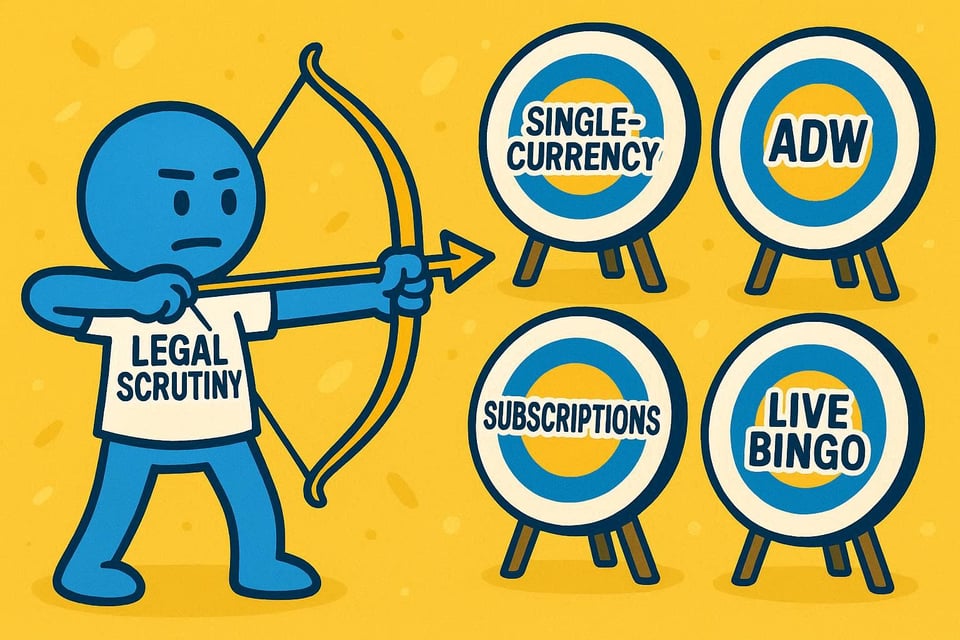
So far, four noteworthy pivot categories have emerged:
- Single-currency model
- Live online bingo
- Advance deposit wagering gaming
- Subscription model
Sweepsy spoke with Charles Farrell, Senior Managing Associate at Dentons US LLP, about the four models. Farrell, a litigation and regulatory attorney who specializes in areas including gaming, crypto, and prediction markets, said that, despite the changes that each model makes, they all still “face legal exposure.”
“The common issue is whether the product’s economic reality is paid chance-based play for redeemable value,” Farrell told Sweepsy. “The more the model resembles staking value on casino-style outcomes for cash or cash-equivalent prizes, the more exposed it is.”
Single-currency model? Still could be ‘legally dangerous’
The single-currency model was the first to emerge after the California Legislature outlawed Sweeps Coin gaming in that state last September, sending a tidal wave throughout the sweeps industry.
First, later that same month, ClubWPT Gold eliminated the use of Gold Coins and Sweeps Coins in favor of a single-currency system tied to poker gameplay and training.
The platform now operates exclusively with Chips, which can be used in both tournaments and cash games. Players cannot directly purchase these Chips, but they are still redeemable for real-money prizes.
To access the games, users instead buy Hand Analysis credits that unlock poker coaching and training features. Alongside those purchases, players receive bonus Chips at no additional cost.
Then there’s Card Crush, which launched in December 2025.
At first glance, Card Crush appears to be a fantasy RPG card battler, complete with Mystery Boxes, treasure chests, and collectible character cards reminiscent of Pokemon or Yu-Gi-Oh.
The platform lets players compete in card matches to climb leaderboards and earn Loyalty Club Points, which unlock stronger cards and Mystery Coins. Players can also buy Mystery Boxes containing both cards and Mystery Coins.
Those Mystery Coins can then be used on casino-style games — and, notably, can also be redeemed for cash.
So, for ClubWPT Gold, Card Crush, and others using a single-currency model, the end result is still similar: Players can redeem currency for real prizes. But the path to get there differs from a dual-currency setup.
What does Farrell think?
“Potentially cleaner cosmetically,” he said, “but legally dangerous if the currency is purchased, staked, and redeemable for value. At that point, the product may look less like a promotional sweepstakes and more like unlicensed wagering.”
Live online bingo? ‘More plausible in some jurisdictions’
Some operators, such as Ruby Sweeps with its Ruby Bingo Live, have entered the live online bingo space, with several scheduled live bingo events throughout the week featuring real cash prizes. Again: The prizes are real cash, not digital currency.
The reason for this particular pivot is likely because online bingo is often regulated differently from traditional online gambling because it may be classified as peer-to-peer or charitable gaming rather than house-banked casino play.
However, many regulators increasingly treat online bingo similarly to gambling when real-money prizes, cash redemption, or casino-style monetization are involved.
“More plausible in some jurisdictions, but only if operated within an applicable state-specific bingo or gaming framework,” Farrell said of the online bingo model. “Bingo is not categorically exempt, and online, interstate, for-profit bingo still raises licensing and gambling-law issues.”
ADW gaming: ‘Likely the most durable’ if structured properly
The model best positioned for long-term viability, Farrell said, is ADW gaming.
This model replaces dual-currency systems with real-money ADW. Instead of relying on chance, these platforms determine casino-style game outcomes using live or historical horse racing results, similar to historical horse racing machines found at racetracks in states like Kentucky.
So why is this arguably the most airtight pivot?
Because Churchill Downs won a critical court case late last year against the Michigan Gaming Control Board. The ruling confirmed that the Interstate Horseracing Act governs interstate horse race wagering, limiting states from imposing additional licensing requirements beyond the federal consent framework. The ruling opened the door for companies to offer casino-style gaming platforms powered by live or historical horse racing results, potentially avoiding the need for traditional online casino licenses because the wagering activity falls under federally regulated horse race betting.
Still, Farrell said, operators choosing to pursue the ADW gaming route need to be mindful of how the gaming structure is actually designed.
“Likely the most durable if genuinely structured as lawful pari-mutuel horse-race wagering through licensed ADW channels and compliant with the Interstate Horseracing Act and state law,” Farrell said. “But if the product merely uses horse-race results as a randomizing mechanism for casino-style games, the legal durability drops sharply.”
Subscription model: ‘Problematic for consideration analysis’
The subscription model is the newest, with likely the least amount of operators tinkering with it yet. In fact, Sweepsy is aware of just one: Thrillaroo, a sister site to Funzpoints.
Thrillaroo uses a subscription model with two gameplay modes.
Chill Mode uses free, unlimited Chill Points that have no cash value and cannot be redeemed, like Gold Coins. Thrill Mode uses purchasable Thrill Tokens, which carry real monetary value and can be cashed out.
Access to the platform requires a paid membership that includes a Win Win Guarantee. At the end of each subscription period, players who lose more than they win in Thrill Mode receive a refund covering the difference, and players who win more simply keep their winnings.
“They may reduce reliance on the old dual-currency structure, but they put payment front and center,” Farrell said of the Thrillaroo structure. “That is problematic for the consideration analysis.”
Thrillaroo is currently operating in California and New York, among other markets. Operators using other gaming models mentioned in this story (Card Crush and ClubWPT Gold for single-currency, HorsePlay for ADW gaming, etc.) are also live in California and New York, the two largest jurisdictional losses so far for the sweepstakes casino industry.