

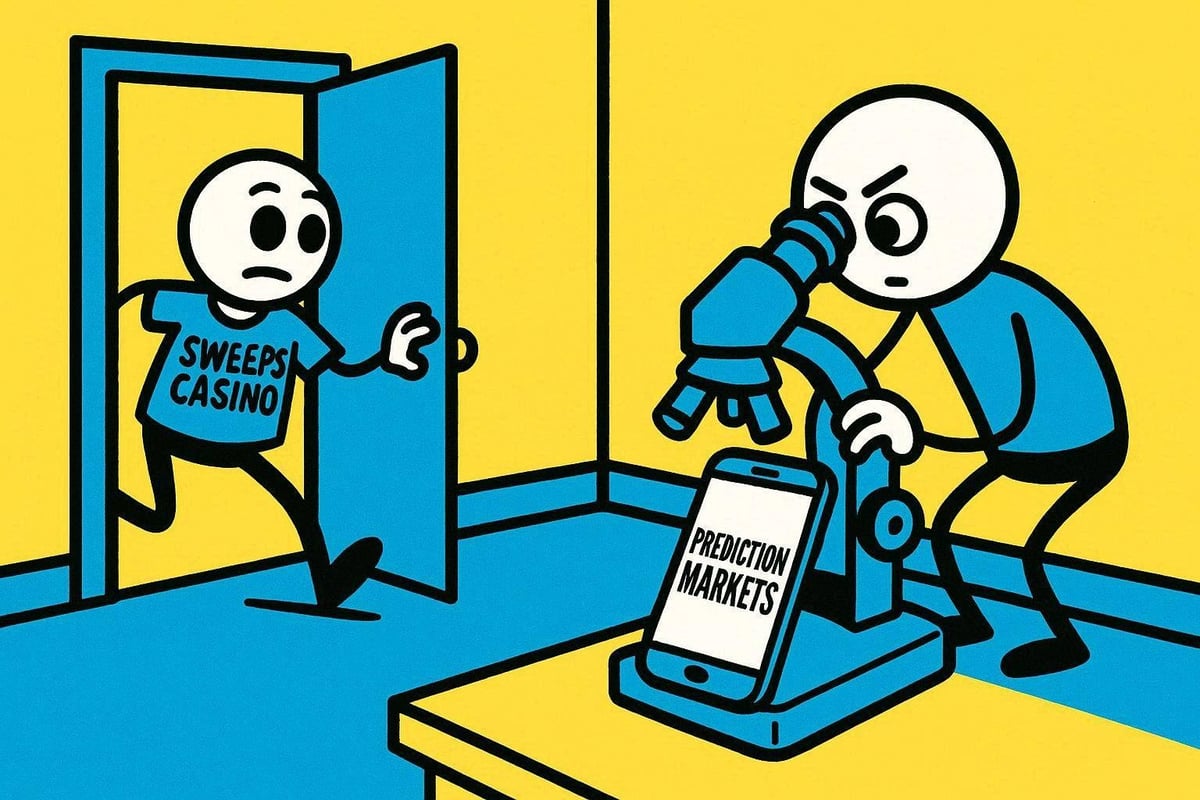
According to data from Google, the difference in online search interest between sweepstakes casinos and prediction markets is quite significant.
Over the last 365 days, per Google Trends, there has been 5.4 times more search interest for “prediction markets” than for “sweepstakes casinos” in the United States. The disparity is even more dramatic when comparing to “sweeps casinos” searches, which “prediction markets” has beat by 9.8 times.
Google Trends is based on a sampled, anonymized group of searches performed on Google. The data sets are normalized so that the reported values reflect relative search interest (scaled from 0 to 100 within the selected time and geography) rather than raw search counts. While not an exact tally of actual searches, it is generally seen as an accurate representation of total volume.
More than 1,000% year-over-year interest growth … vs. 70%
When it comes to sweepstakes casinos, some individual brands actually performed better in terms of Google search volume than searches related to the overall industry.
Searches for “Chumba Casino” logged a 3.2 times higher interest score than the “prediction markets” searches. “Pulsz” searches had twice the interest score. Still, interest in Chumba Casino and Pulsz paled in comparison to interest in the two most notable prediction markets platforms, Kalshi and Polymarket.
“Kalshi” and “Polymarket” searches both recorded an interest score twice as large as “Chumba Casino” searches and more than three times that of “Pulsz” searches.
If we just look at the industry interest, the year-over-year numbers are striking.
There was 70% more interest in “sweepstakes casinos” searches this past year compared to the prior year. Meanwhile, there was 1,150% more interest in “prediction markets” interest this past year compared to the prior year.
Honestly? Not surprising at all.
Legislatures mirrored that Google interest in 2026
That disparity in interest was reflected in 2026 legislative sessions, as well.
According to the National Conference of State Legislators, more than 15 states introduced nearly 40 pieces of legislation in 2026 targeting prediction markets in some form or fashion. Minnesota Gov. Tim Walz signed into law in May a bill banning prediction markets in the state. There have also been federal bills filed to either ban prediction market platforms from offering event contracts resembling sports betting or casino gaming, as well as bar senior members of the government from using prediction markets apps.
Meanwhile, in the 2026 legislative session, 12 states considered bills targeting sweepstakes casinos. Five passed bans into law. Five saw their bills fail. Iowa passed a bill allowing the state regulator to issue cease-and-desists to sweeps casinos. And a bill was filed in Washington, DC to legalize real-money iGaming and ban sweeps casinos, but it appears to have stalled out.
While there is still certainly scrutiny on the sweeps industry, there has undoubtedly been a shift in focus to prediction markets. That’s the natural course of the gaming ecosystem, one of the industry’s leading legal experts told Sweepsy.
“History teaches us there will then be something else after prediction markets that take up all that oxygen. I don’t think people in this industry have a long memory,” said Josh Kirschner, the Deputy Team Leader of Holland & Knight’s newly formed Gaming Practice, where he advises a diverse range of gaming clients, including sweepstakes operators.
Kirschner said those leading the charge against sweeps, such as social casinos and gaming tribes, “will continue” to try to shrink the sweeps industry. But the legality of sweeps is no longer and will no longer be the dominant debate in the gaming world, Kirschner said.
“I do not think that we will have another situation where sweepstakes are the focus of conversation, let’s say, at a G2E or iGaming NEXT, any conference of your pick, as it was not this most recent year but the year before,” he told Sweepsy. “And so maybe that’s a long-winded way of saying this goes a bit on the back burner. But man, as with all things in politics, it only takes one stroke of the pen for it to come back around.”
Shift in focus could be a double-edged sword
The kneejerk reaction may be to assume reduced attention on sweepstakes casinos could only be a good thing for the industry. Less attention means less scrutiny, right? And fewer bills and cease-and-desist letters?
Perhaps. But also not necessarily, Kirschner said.
“Maybe it could be actually easier to push [sweeps bans] along if there’s less eyeballs on them,” he said. “It could be that it will be easy. There’s less eyeballs on a regulatory bill that straight prohibits sweeps. Or, again, that cuts both ways — it could be it’s easier to push through something in a budget, or you find a creative way to do it through a budget bill, that regulates sweeps or creates a new kind of tax revenue stream. Every state is different on this stuff, but it could go either way.”
Obviously only time will tell what the evolving sweeps landscape looks like with any further legislative action. We’ll see which states consider bills targeting the industry in 2027. But, the trend continues the same as it did from 2025 to 2026, we may see even less activity in 2027 — or at least less meaningful activity.
Before the 2026 legislative season, opponents of sweepstakes casinos predicted a watershed year that would severely injure the industry. Although operators did lose a handful of states, the results were less drastic than some expected. In fact, Kirschner said he views 2026 as an “inflection point” for the sweeps industry more than anything else.
Sweeps Coin gameplay was outlawed in Indiana, Maine, Louisiana, Oklahoma, and Tennessee. Yet those market closures don’t nearly compare to the previous year’s exits from California, New York, and New Jersey.
Overall, 2026 wasn’t really a decisive victory for either side of the debate. Remember, five ban bills passed (plus Iowa’s unique bill), and five failed. But it didn’t match the magnitude of 2025, suggesting 2027 may not match 2026, either.