

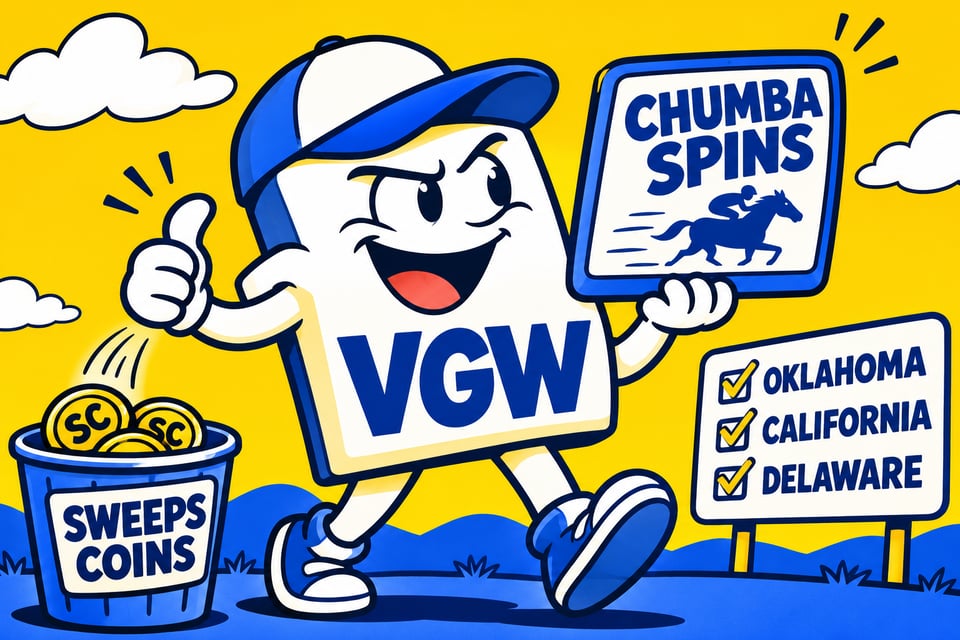
With bans and lawsuits shrinking the sweepstakes gaming map, VGW is building for markets where Sweeps Coins are gone. Its newest product doesn't use them at all.
Chumba Spins, a closed-beta, waitlist-only product, is live in Oklahoma, California, and Delaware. It appears to work much like a historical horse racing machine, tying slot-style results to horse races, and its terms name Game Play Network, a licensed advance deposit wagering (ADW) hub, as the company running the wagering.
It seems to be a legally viable pivot, and possibly a sturdier one than many alternatives operators have tried amid the recent wave of scrutiny.
Why operators need a way out of dual-currency
The pressure on Gold Coins and Sweeps Coins isn't letting up. California, New York, and New Jersey shut down sweeps casinos in 2025. In 2026, five more states passed bans: Indiana, Maine, Louisiana, Oklahoma, and Tennessee.
Wyoming and Pennsylvania have already pre-filed bans for 2027, and more states are expected to attach sweeps bans to iGaming bills this legislative session.
VGW has felt the pressure as much as anyone. In September, it agreed to pay New York $8 million although it didn't admit fault related to what the state's attorney general accused it of. VGW is also facing lawsuits from Kentucky and Florida.
How the other pivots stack up
In May, Sweepsy asked Dentons attorney Charles Farrell to assess four emerging pivots. He said all of them still face legal exposure, and that the core issue is "whether the product's economic reality is paid chance-based play for redeemable value."
Here's how he sized them up:
Single-currency (ClubWPT Gold, Card Crush): "Legally dangerous" if the currency is purchased, staked, and redeemable for value.
Live online bingo (Ruby Bingo Live): "More plausible in some jurisdictions," but "not categorically exempt."
Subscription (Thrillaroo): Puts payment front and center, which is "problematic for the consideration analysis."
ADW gaming (HorsePlay and others): "Likely the most durable if genuinely structured as lawful pari-mutuel horse-race wagering through licensed ADW channels and compliant with the Interstate Horseracing Act and state law."
Six months later, three pivots appear to be the main paths forward: single-currency or card game-based ecosystems, collectibles and rips, and ADW. (However, the Wyoming bill slated for 2027 names single-currency models explicitly so we’ll see if that starts a trend.)
Collectibles and rips are quickly gaining popularity. Modo just debuted a "Super Gaming App" with Modo Rips as one of its three pillars, and Crown Rips and MyPrize Packs are also in the mix. The pitch is that players get an actual collectible and can often sell it back.
Why Chumba Spins has the strongest legal argument
No pivot is airtight. But Chumba Spins has three things most alternatives don't.
Chumba Spins doesn't need to try to convince regulators it doesn’t equate to real-money gambling, because it's openly a real-money product with no Sweeps Coins. Its argument is that the play is legal wagering, not that it isn't wagering.
ADW models lean on the Interstate Horseracing Act, which recently held up against a state regulator. In January, a federal judge ruled for Churchill Downs against Michigan's regulator, finding that the state's in-state racetrack requirement added an extra layer of consent Congress never approved.
The Chumba Spins terms name Game Play Network, not VGW, as the wagering provider. That's the "licensed ADW channels" piece of Farrell's test.
HorsePlay and Lonestar.bet also use GPN, so VGW's legal structure isn't unique.
How Chumba Spins fits VGW's broader strategy
Chumba Spins is part of VGW’s broader effort to diversify while keeping its sweeps and social businesses running.
On the sweeps side, VGW closed LuckyLand Slots in September to focus on LuckyLand Casino, Chumba Casino, and Global Poker, and Chumba now has a full iOS app. It has also kept Gold Coin-only gameplay live in states where Sweeps Coins have been removed.
Beyond sweeps, Monopoly Match gives VGW an avenue in mainstream mobile gaming through in-app purchases, while Chumba Spins offers a real-money path in states where Sweeps Coin play is banned.
Are there any vulnerabilities?
The biggest threat to Chumba Spins and other ADW-fueled platforms could be the second half of Farrell's assessment. If a product "merely uses horse-race results as a randomizing mechanism for casino-style games," he said, "the legal durability drops sharply."
The Churchill Downs case involved horse race betting, not casino-style games, and ZwillGen attorneys wrote in September that they believe it doesn't create a safe harbor for ADW-fueled gaming.
In California, officials cracked down on historical racing machines by removing 26 from Santa Anita in January, although those were physical machines and not an online product.
And in his lawsuit against VGW and Stake, Florida Attorney General Jason Uthmeier said, "If it looks like a casino, takes real money like a casino, and pays out like a casino, it is a casino." ZwillGen cites that as a warning for ADW gaming, as well.
Time will tell.