

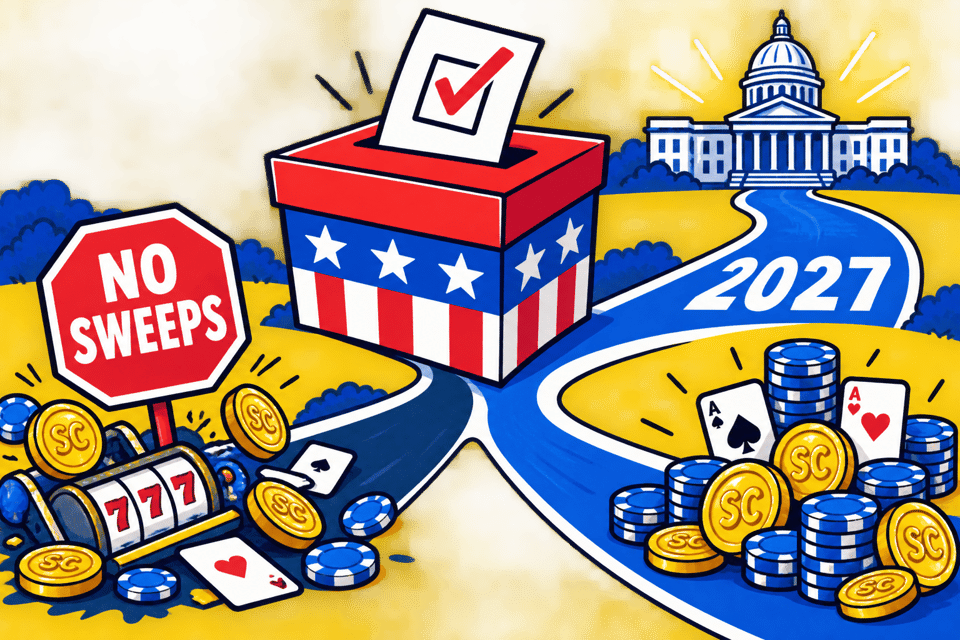
Sweepstakes casinos won't appear on any ballot Tuesday.
But in several states where ban bills are pre-filed, old ones have stalled, or new ones are freshly enacted, voters will choose the governors who sign or veto them and the legislators who chair the committees that decide whether they get a hearing.
Here's where the election could matter most for stakeholders around the sweeps industry.
Pennsylvania: Lawmaker behind sweeps ban up for re-election
Pennsylvania may be the clearest case. Every one of the state House's 203 seats is on the ballot, and Democrats hold a 103-100 majority. Republicans control the Senate 27-23, with half of its seats up.
That margin matters for House Bill 2801, Rep. Russ Diamond's pre-filed bill to ban dual-currency sweepstakes casino games with fines up to $500,000. Diamond is the Republican chairman of the Gaming Oversight Committee, but Democrats hold the majority, and the committee's majority chair is Democratic Rep. Pat Harkins.
Diamond himself is on the ballot, seeking re-election in the 102nd District.
Whether he gets re-elected or not may have a significant impact on the fate of HB2801.
Alabama: Sweeps money in the governor's race
Alabama has no lottery and no casinos, yet sweepstakes casinos still operate there.
Sen. Tommy Tuberville, who is running for governor, received $30,000 from VGW Luckyland in March, and VGW later added a $100,000 contribution. In all, VGW has put $351,000 into Alabama races this cycle. Tuberville has said gambling expansion decisions belong to the legislature, not the governor.
A donation doesn't establish a policy position, but it signals that at least one major sweeps operator is paying attention to who’s the executive power in Alabama.
Arizona: VGW backs the lawmakers and a would-be Attorney General
Arizona is one of the toughest states in the country on sweepstakes casinos, and it got there without passing a law. The Arizona Department of Gaming has sent cease-and-desist letters to operators including Pulsz, Modo.us, Fliff, Thrillzz, Stake.us, High 5 Casino, Rebet, and Betty Sweeps over the past two years.
But the legislature has never considered a bill outlawing them.
VGW, which has not received an Arizona cease-and-desist and still offers Sweeps Coin gameplay there, has given $70,000 to three Arizona Republican organizations this cycle:
Arizona Senate Victory Fund PAC: $30,000
House Victory Fund: $30,000
Restore Order Arizona: $10,000
The first two exist to protect Republican majorities in the legislature, the body that would decide whether Arizona ever passes a sweeps ban. Restore Order Arizona has been spending to support Senate President Warren Petersen's campaign for Attorney General. That office, currently held by Democrat Kris Mayes, plays a central role in any potential enforcement against sweepstakes casinos
These contributions seemingly give VGW a stake in both the lawmakers who decide on gaming laws and the office that enforces them.
Oklahoma: The ban is law … but the governor who vetoed it is leaving
Oklahoma's sweeps ban takes effect Nov. 1, two days before the election. Gov. Kevin Stitt vetoed Senate Bill 1589, but lawmakers overrode him 34-10 in the Senate and 68-19 in the House.
Stitt is term-limited. The race to replace him is Republican Mike Mazzei against Democratic House Minority Leader Cyndi Munson, and Mazzei is the heavy favorite. Both candidates have promised closer cooperation with Oklahoma's tribes, which backed the sweeps ban, after years of friction under Stitt.
The next governor won't need to sign a sweeps ban. But the new administration will oversee enforcement against holdouts, and gaming observers expect the improved tribal relationship to revive sports betting talks when the legislature convenes Feb. 1.
Maryland: A ban that keeps passing one chamber
Maryland has now seen sweeps bans clear one chamber two years running and die in the other. The Senate passed one 47-0 in 2025 before it stalled in the House. In 2026, the House passed two ban bills, but neither moved through the Senate before the session ended April 13.
Maryland's full General Assembly is up for election this year. Turnover on the relevant committees could determine whether 2027 finally produces a bill both chambers agree on.
Indiana: Prominent industry ally steps back
Indiana already banned Sweeps Coin gameplay this year. But the election could cost the industry one of the few lawmakers anywhere who publicly backed regulating sweeps instead of banning them.
Republican Sen. Ron Alting, who has represented District 22 since 1998 and is seeking an eighth term, announced Oct. 7 that he was stepping back from active campaigning while undergoing medical evaluation and treatment. The announcement followed reports alleging shoplifting incidents at two Walmart stores. Alting acknowledged concerning changes in his judgment and cognitive functioning.
He remains on the Nov. 3 ballot against Democrat Natasha Baker, a teacher from Battle Ground. Indiana's deadline to voluntarily withdraw passed July 15. If he wins and later resigns, a caucus of Republican precinct committee members would pick his replacement. Local GOP leaders have said it's too early to say what happens.
Alting was the Senate sponsor of House Bill 1052, the ban that took effect July 1. In February, he prepared an amendment to regulate and tax sweeps instead but never called it, citing a strong "no go" from leadership in both chambers. He told the committee there would be another session to revisit it.
He wasn't alone. House members Steve Bartels, Jim Lucas, and Cory Criswell also pushed for regulation over a ban. But whatever happens Tuesday, a vocal sweeps ally is unlikely to be leading that fight in 2027.
Also worth watching
Texas: The lieutenant governor controls the Senate agenda. Democratic nominee Vikki Goodwin has supported putting casinos and online sports betting before voters, though markets favor incumbent Dan Patrick. Texas remains one of the largest open sweeps markets.
Florida: At least $12.2 million from gambling interests entered the 2026 cycle through July, with Republican gubernatorial candidate Byron Donalds the largest beneficiary at about $6 million. VGW alone has given $562,500 to Florida candidates and committees since December 2025, including $100,000 to Donalds. Florida has not legislatively banned sweepstakes casinos, although Attorney General Jason Uthmeier recently filed what could turn out to be a landmark lawsuit against sweeps operators.
Tennessee: VGW gave $15,000 to a PAC backing Republican Sen. Marsha Blackburn's run for governor, the Tennessee Lookout reported. Blackburn has been active on gambling policy in Washington. She chaired a May 2026 hearing on the growth of sports betting and addiction, and she has criticized prediction markets for offering sports contracts outside state oversight.
Kentucky: The conservative Commonwealth Conservation Coalition PAC received $25,000 from VGW this cycle, according to WKYU-FM. Churchill Downs gave the same group $100,000.