

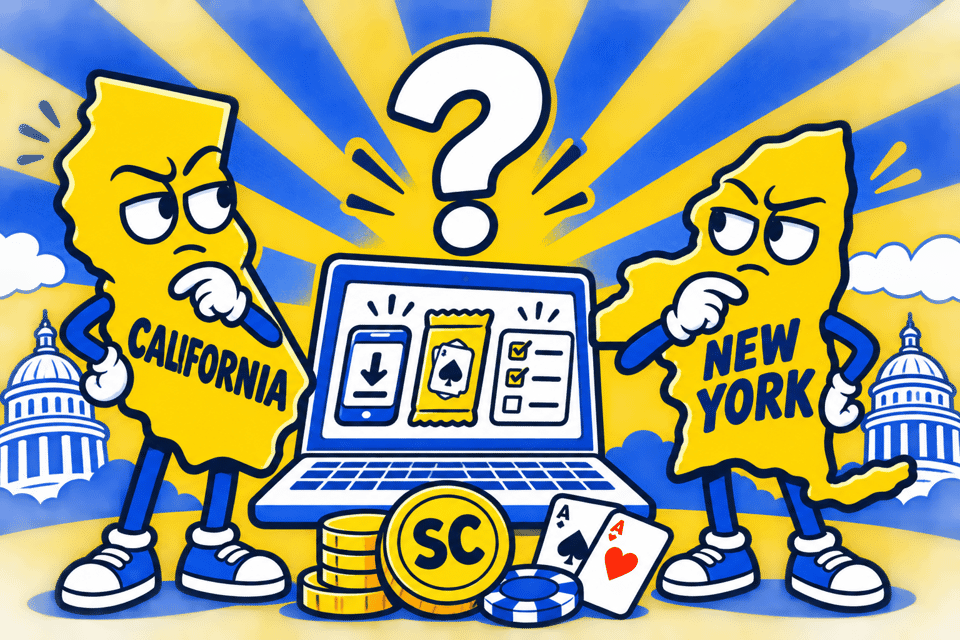
California and New York present conundrums for sweepstakes casino website operators. While they are the most and fourth-most populous states in the United States, they also have explicit sweepstakes gaming restrictions in their state codes.
Those populations form natural incentives to find a way to avoid enforcement under those statutes while still providing some form of the casino-style games with real-money redemption options that have made such websites popular. Schema toward that end have emerged.
Some companies are tying the award of digital tokens that may be redeemed for cash prizes after meeting playthrough requirements to users downloading partner apps or completing online surveys. Others have shifted to granting such tokens as a "bonus" of digital pack rips.
The theory of these potential workarounds is not new, even if the mechanics of these specific circumstances represent novel delivery methods. Attorneys in California and New York feel that the companies attempting these methods are on shaky legal ground.
California, New York laws target dual-currency packages on sweepstakes casino sites
California enshrined its sweepstakes casino ban in September 2025. New York followed suit shortly thereafter. Both statutes address dual-currency digital token packages that sweepstakes casinos have operated on.
California's law states that using "a dual-currency system of payment that allows a person to play or participate with direct consideration or indirect consideration, and for which the person playing or participating may become eligible for a prize, award, cash, or cash equivalents or a chance to win a prize, award, cash, or cash equivalents" as one of the conditions for violating the statute.
New York's law is very similar in terms of including a requirement for potentially violating websites to utilize "a dual-currency system of payment allowing the player to exchange the currency for any cash prize, cash award or cash equivalents."
As that is among the required conditions for potential violations of the statutes, some website operators have pivoted away from the "buy one currency, get the other as a bonus" method. That's where the apps, cards, and surveys come in.
Apps, cards, and surveys fill in as player participation mechanisms
Companies like AceBet have started giving players new options for earning coins that they can use to play games on their sites.
Downloading and registering for accounts on specified mobile applicationsFilling out online surveysPurchasing digital packs of physical trading cards
In these app and survey systems, no purchases are necessary. In the trading card model, the cards essentially take the place of the gold coins as the item being purchased with the playable digital tokens being a "bonus."
Tying digital tokens to a physical commodity like trading cards or a customer action like survey completion is not a new concept. In fact, courts in both states have encountered this theory before.
California sweepstakes casino ban was resolution of legal question seven decades in the making
Jasmine Mines, a California-based attorney, explains case law that was relevant in the state preceding the enactment of the state's sweepstakes casino ban.
"The theory rests on one of the oldest ideas in sweepstakes law: if players can get the game currency for free, or receive it as a 'bonus' with something they bought, they have not paid for the chance to win," Mines said. "California’s Supreme Court once accepted a version of that argument. In California Gasoline Retailers v. Regal Petroleum Corp., the court held that gas station prize giveaways were not illegal lotteries because anyone could get a ticket without buying anything, and it said that a more realistic approach to consideration was an argument to direct to the Legislature, not the courts. 67 years later, the legislature took up that invitation."
Mines adds that the trading card model is nothing new as well.
"California courts have also seen the product-sale structure before," Mines commented. "In People ex rel. Lockyer v. Pacific Gaming Technologies, a company sold prepaid phone cards from machines that also ran a sweepstakes with spinning reels, and it offered a free mail-in entry. The Court of Appeal held the machine was an illegal slot machine anyway, adopting the reasoning that once chance and a prize are attached to a product, the customer is no longer paying solely for the product."
New York Attorney Linda Goldstein explains that there are "some old cases on the books dating back to the 1930's and 1940's that aggressive regulators could resurrect if they wanted to challenge this format." In either state, enforcement of the statutes and defending against such enforcement both present questions that judges would have to consider.
Enforcement potentially surfaces questions over legal definitions
Operators of sweepstakes casino websites have argued that their games don't fit statutory definitions of gambling, which is part of the reason why some states have enacted statutes that explicitly include the dual-currency sweepstakes system in gambling statutes. To an extent, the novel models merely shift the legal definition questions to other terms.
For example, Goldstein doesn't consider any of the app, survey, or trading card systems as clear-cut, facial violations of New York's sweepstakes casino ban. She points to a unique component of the New York law in that discussion.
"It is also important to note that just because these models don't fit within the strict language of these laws doesn't necessarily mean they are legal," Goldstein explained. "The statute expressly leaves it to the Gaming Commission to 'determine what constitutes a dual-currency system,' and the answer to that question will have significant implications."
Goldstein adds that the trading card system "still leaves open the fundamental question as to whether the payment of money to receive a 'randomized' product violates the gambling laws simply because of the randomized nature of the product."
Defense against enforcement actions in either state could prove equally complicated
In New York, any operator that comes under scrutiny might mount a similar defense to companies that have deployed these theories in the past. That likely begins with arguing that the law does not apply to their products.
"Operators who have pivoted to selling cards or posters will argue they are bona fide retailers of collectibles with a promotional bonus, analogous to traditional sweepstakes incidental to a real product sale and that they have accordingly eliminated the element of a 'prize,'" Goldstein elaborated. "The operators will also point to long-standing precedent that buying randomized trading-card packs is not gambling because the buyer always receives the cards purchased, such as the Ninth Circuit's Chaset v. Fleer/Skyboxdecision. For surveys and app offers, as noted above, the defense is that no consideration is paid by the player at all; the player is providing time or data, not staking money. Again, these models can be distinguished from the precedent upon which they are relying so we will have to see how these issues play out in the courts."
Sweepstakes casino promoters may use similar but not identical defenses in California as well according to Mines.
"Where the theory may actually try to find room is not in the coins but in the prizes," Mines stated. "Section 337o reaches a game only if it meets every element, and one element is that the game 'awards cash or cash equivalents.' Cal. Penal Code § 337o(c)(3)(D). The companion amendment to the Business and Professions Code likewise says it does not make unlawful a game that does not award cash or cash equivalents. If winnings can be redeemed for cash or gift cards, that element is satisfied. If the company instead pays out merchandise, such as rare or graded trading cards, it will likely argue that its prizes are not cash equivalents."
At the same time, Mines stresses that California's "statute does not define the term" of "cash or cash equivalents."
"A collectible card that can be sold on a secondary market within minutes sits uncomfortably close to cash, and I would expect that question, rather than the 'bonus' label, to be where any serious legal fight over this model takes place," Mines added. "A company that escapes section 337o is also not automatically lawful. The same bill provides that nothing in the amended Business and Professions Code section legalizes conduct prohibited by California’s older lottery and slot machine statutes."
Because litigation could involve arguments over language, avoiding that unpredictable scenario could be ideal for sweepstakes casino operators. One of the most prominent companies in that industry, Virtual Gaming Worlds (VGW), has reached terms with New York authorities to resolve an enforcement action.
However, Goldstein doesn't believe that replicating those circumstances is cut and dry for all other enterprises.
VGW settlement with New York isn't necessarily a "road map" to legal operation
New York Attorney General Letitia James announced that she reached a settlement with VGW in September. VGW agreed to pay $8 million to the state and not offer cash-redeemable coins or other items with real-world value.
In exchange, James resolved the enforcement action. However, the settlement leaves room for authorities in the state to revive that action should they have concerns that VGW is out of compliance.
Goldstein says that companies should not read that as legal cover for games that don't use a dual-currency system in New York, though.
The "settlement with VGW does not talk about dual-currency," Goldstein noted. "It really tracks traditional gambling laws and prohibits enabling a consumer to stake or risk something of value on the outcome of a contest or chance or future contingent event not under the consumer's control or influence upon an agreement or understanding that the consumer will receive a Redeemable Virtual Item in the event of a certain outcome. One other interesting thing to note in the settlement; the prohibition is not limited to 'requiring' a person to stake or risk something of value but 'enabling' them to do so which does raise the question of whether having an alternative method of entry will provide a sure defense."
For operators in New York, the situation is also complicated because the attorney general's office isn't the only state authority with power to take enforcement actions. Partners of the operators could face liabilities there and in California as well.
Exposure for game providers, payment processors, and other vendors
The New York statute's empowerment of gambling regulators to take action against potential violations increases the liability for not only sweepstakes casino websites but their partners as well in Goldstein's estimation.
"The boundary operators are relying on can be redrawn by the regulator without new legislation," Goldstein verbalized. "As far as I am aware, the Commission has not yet issued that determination. When it does, it could sweep in product-plus-coin models. Second, the Commission can independently investigate, hold hearings, issue cease-and-desist letters and issue subpoenas. The statute's reach beyond operators adds to that risk. It also prohibits payment processors, geolocation providers, content suppliers, platform providers and media affiliates from supporting these games. Fines run $10,000 to $100,000 per violation, and violators can lose or be barred from a gaming license. That gives the Commission a practical way to cut off an operator's vendors and marketing partners, many of whom are licensed or want to be. In short, enforcement no longer depends on one office's priorities, and a 'test the waters' strategy now carries exposure on multiple fronts."
The situation is similar in California according to Mines.
"Section 337o separately reaches payment processors, platform providers, and gaming content suppliers that knowingly and willfully support an online sweepstakes game in California. Every business that helps sell the cards and run the games carries its own exposure," Mines said.
Because of all these factors, both counselors recommend high levels of caution for operators in the space in California and New York.
Rewards may not merit the risk in California and New York
Mines makes clear that the California law has little room for experimentation.
"The statute preserves one narrow path for legitimate businesses: promotions conducted on a limited and occasional basis, incidental to substantial bona fide sales of consumer products, and not intended to provide a vehicle for ongoing gambling or gaming," Mines explained. "That exception was built for the cereal box sweepstakes, not the always-open casino lobby. A simple way to frame the question is this: if the coins disappeared tomorrow, would customers keep buying the cards? If the honest answer is no, the cards are not the business. They are the entry fee."
Goldstein also endorses an extremely conservative approach that the apps/surveys/trading card models may not fit into.
"My advice to a client would be that the absence of enforcement against a new model reflects that it is new, not that it is necessarily lawful," Goldstein stated. "Any New York launch should be preceded by a written legal analysis, conservative product design (no casino-style games for redeemable coins), and a plan for a quick exit if a regulator objects. That analysis really needs to consider the entire body of jurisprudence surrounding sweepstakes and gambling laws as each of the current models raise issues that have been previously addressed and need to be considered to make an informed risk assessment. There is also no sign the enforcement climate is softening."
Like with those who play the games on the sites offering these models, the operators and their partners are running risks in California and New York. The apps, surveys, and trading cards may not offer the protection that these companies desire.