

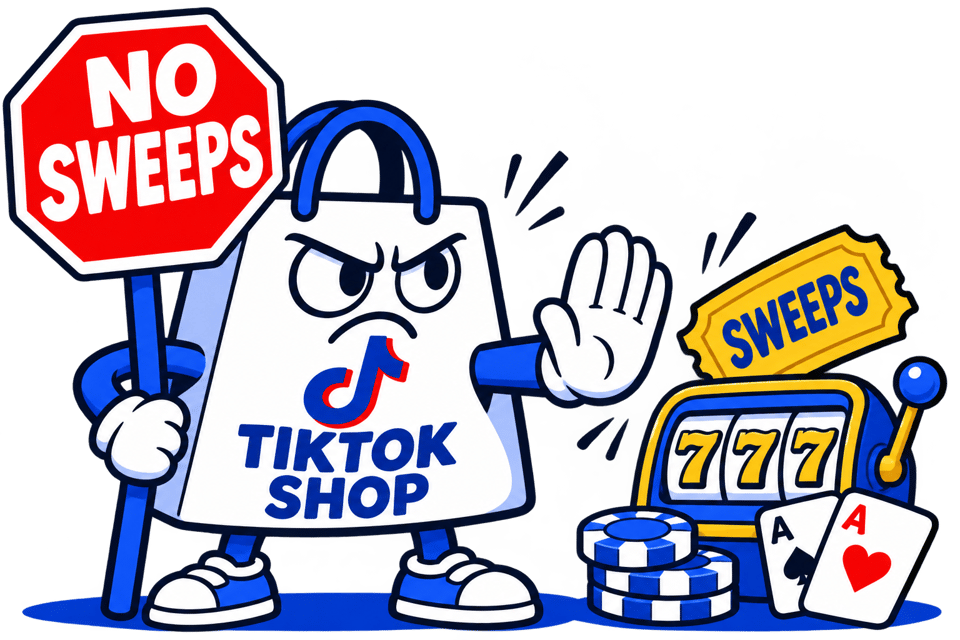
TikTok has restated that gambling is not allowed in its commerce ecosystem, and this time it named sweepstakes gaming right alongside raffles, lotteries, and spin wheels.
Released this week through TikTok's US Academy and first reported by iGaming Today, the updated policy says gambling, sweepstakes, and other chance-based promotions are not allowed on TikTok Shop. It applies to both sellers and creators and covers giveaways, auctions, mystery products, and livestream sales.
TikTok's latest release removes any doubt: On TikTok Shop, sweepstakes are named, banned, and treated like any other gambling product — despite sweeps operators consistently and emphatically arguing they don’t offer gambling.
What the policy says
TikTok Shop bans charging customers for a chance to win a prize or a mystery reward. It also bans any gambling-related promotion, including raffles, lotteries, wagers, sweepstakes, lucky draws, and spin wheels. The only permitted prize route is a free giveaway run through TikTok's official LIVE Giveaway feature, and winners can't be picked by chance.
Violations can mean listing removals, refunds, and loss of selling privileges.
What it means for sweepstakes casinos
Sweepstakes casinos sell Gold Coin packages that typically come with bonus Sweeps Coins redeemable for cash prizes. Operators argue that a free mail-in entry and other alternative modes of entry (AMOE) keep the model legal, but TikTok's Shop rules disagree.
Paying money for a chance at a redeemable prize is exactly what the policy calls gambling. That rules out selling Gold Coin packages through TikTok Shop, "spin the wheel” or lucky-draw promotions for Sweeps Coins, third-party giveaway tools, and mystery-reward bundles.
Beyond the Shop policy, TikTok's Community Guidelines also ban content that markets gambling or gambling-like activities. Its ad policy requires gambling advertisers to be certified and bans ads for unlicensed gambling, and its branded content rules list sweepstakes under gambling. Because most sweeps operators hold no state gambling license, the certified route is effectively closed. That helps explain why sweeps operators’ social giveaways happen mostly on X, Facebook, and Instagram.
The pressure is political, too. In late September, Florida Attorney General James Uthmeier gave Google, Meta, Reddit, Snap, and TikTok until Oct. 23 to explain how they plan to keep ads for sweeps casinos away from players in Florida. That request came after Uthmeier filed a lawsuit against VGW and Stake in August.
How other social media platforms compare
Meta (Facebook and Instagram)
Meta allows real-money gambling ads only after an advertiser completes its authorization process. As Sweepsy has reported, Meta's definition of online gambling explicitly lists sweepstakes gaming. Social casino ads skip approval only if they offer no chance to win anything of monetary value, a test sweepstakes casinos can't pass.
Google and YouTube
On Oct. 28, 2025, Google added one line to its ad policy: "Examples of games that are not social casino games: Sweepstake casinos." Sweeps operators lost the social casino label they had been advertising under and now face real-money gambling rules that require licensing.
YouTube followed on Nov. 17, 2025, reclassifying sweepstakes gaming videos as gambling content and age-restricting them. That came after it had already banned links, logos, and mentions of uncertified gambling sites. Still, certified gambling advertisers can now buy the YouTube Masthead, the top slot on YouTube's homepage.
A ThoughtLeaders analysis found sweepstakes casino sponsorships on long-form YouTube videos fell from 155 videos on 32 channels to 13 on six over the past year.
X, Snapchat, and Reddit
X still accepts authorized gambling ads in markets where gambling is legal. On Feb. 13, 2026, though, it banned gambling, including social casinos, from creator paid partnerships.
Snap requires every gambling advertiser to be pre-approved and to show proof of a license.
Reddit treats gambling as a restricted ad category that gets extra review.
Twitch and Kick
Twitch banned streams of unlicensed slots, roulette, and dice sites in 2022.
Kick, which is linked to Stake, became the gambling-friendly alternative. Even Kick, though, prohibits gambling with viewer money, including buy-ins through sweepstakes.
Influencers and TikTok's enforcement
TikTok casino influencers are one of the fastest-growing forces in online gaming. Many use TikTok as a funnel to attract viewers to longer streams on Kick, Twitch, and YouTube.
TikTok's enforcement in the gambling space has often affected people who actually aren't promoting gambling at all:
Jim Curry, host of the safer-gambling podcast Better Gaming Show, was permanently banned over content about lottery compliance, according to CasinoBeats. His appeal failed, but his account came back shortly after he protested on LinkedIn.
Kate Susabu, an Australian campaigner against gambling ads, had her petition video removed twice. The block was lifted after The Guardian contacted TikTok.
Rendy_Vlad, a Cork-based creator with about 1.1 million followers, was banned in late October 2026, mainly for harassment. His videos had been linked to promoting Rainbet, an unregulated crypto casino.
Big U.S. slots names such as Brian Christopher, Lady Luck HQ, and Vegas Matt remain active on TikTok, mostly with videos of them at retail casinos. Christopher, who has promoted VGW sites, was a co-defendant in a California class action lawsuit against VGW, although a judge cleared him last month.