Although the industry had faced question marks and raised some eyebrows in prior years, it’s fair to say sweepstakes casino operators are about two years into a newfound wave of legal scrutiny and regulatory pressure that has already changed the sweeps ecosystem.
Last year saw significant jurisdictional shutdowns in states like California, New York, and New Jersey, officially kicking off the market shrinkage that continued into 2026 — although the final results of 2026 may not match those that the anti-sweeps coalition forecasted.
Legislatively, five states passed bills banning sweepstakes casinos, and similar bills failed in five other states. So, despite the continued clampdown, there were also wins for sweeps operators.
So how should 2026 be remembered?
As a mixed year?
A victory for anti-sweeps advocates?
Or proof that the industry is more resilient than many expected?
Sweepsy discussed this topic with Josh Kirschner, the Deputy Team Leader for Holland & Knight’s new Gaming Practice, which has coalesced all the massive firm’s practices that have worked with gaming into one unified group. Along with Katherine Baker, the Team Leader, Kirschner works with a variety of clients in the gaming industry — including sweeps operators.
‘2026 was not the end of sweeps’
Kirschner pushed back against the notion that the sweeps industry is doomed.
“Let’s start with the obvious: 2026 was not the end of sweeps,” he told Sweepsy, “because there are more sweepstakes operators than ever who are still operating in all sorts of places across our country without having to hide from the authorities.”
What did happen in 2026, Kirschner said, is more concrete: One model — the classic dual-currency model used by most traditional sweeps casinos, with redeemable Sweeps coins and non-redeemable Gold Coins — faced new bans in Indiana, Maine, Oklahoma, Louisiana, and Tennessee.
But …
“I don’t see that as a demise. I don’t see a demise forthcoming,” he said. “What I see is what happens in growing and evolving industries all the time, which is regulators and legislators catching up to issues, and then those who are already in the space innovating and responding to that legislation and regulation in a new way.
“And it’s not some game of cat and mouse, necessarily. I think it’s what is healthy in any industry — that you start with nothing but blue sky, and then you move, respond, fade, jab, and step back as there becomes reactions to what those are, and you find new pathways. I think this is a very healthy place.”
Still, you certainly can’t call 2026 a success for the sweeps industry either, Kirschner argued.
“At least from my point of view, a successful legislative session looks like a legislative session where lots of bills pass that are recognizing that this should be a regulated industry,” he told Sweepsy, “not a world where folks representing these companies have to keep killing bills because those bills are very binary — either this is legal or this is illegal.”
Could this ‘pivot point’ for sweeps mirror the DFS pivot to DFS 2.0?
Even though Kirschner doesn’t think 2026 marked the beginning of the end for sweeps casinos, as those in opposition to the industry have suggested, with increasing market closures, Attorney General actions, and site shutdowns as their proof, he does still think 2026 marks a critical juncture for the sweeps gaming industry.
He called 2026 “an incredibly interesting inflection point, where what is acceptable today might not be acceptable tomorrow.”
“Perhaps this is the pivot point away from dual currency being the dominant model, and more towards a model of what ClubWPT is operating or Modo is operating or any of these others that I’m not giving credit to that deserve it,” Kirschner said, alluding to the single-currency model used by ClubWPT Gold and the new gamified loot box arm of the Modo.us platform. “No one looks back on DFS and says, ‘Boy, the introduction of peer-to-peer in a DFS 2.0 model was the demise of DFS,’ right? It’s a celebrated moment. It is a huge milestone of legitimacy for those companies, that they should all be recognized for. And it was a shrewd move on their parts. Perhaps 2026 is looked at in that way for sweeps.
“Any industry that is not always having that conversation about what not just survival looks like, but success looks like, thriving looks like, the landscape in five years — any industry or any major industry player that’s not having that conversation is dead on arrival, to me. It is not a sustainable way to operate in any space, let alone a space like gaming, and let alone a space like sweepstakes casinos. That conversation needs to be happening at all times.”
Beyond adapting to new gaming models, Kirschner believes 2026 needs to be a turning point for the way the sweeps industry members work with those scrutinizing them — and with each other.
“The industry will have to work harder to find consensus, to find common ground with legislators, regulators, and with those who are in the industries that oppose these companies,” he said. “I think it means that sweeps companies will also need to double down on consumer protection, on setting standards themselves and holding themselves to account in that way, so there can be a real bifurcation between those that treat this as a serious legitimate business and those that are abusing the system to take advantage of vulnerable people or gaps in regulation and systems.”
Kirschner says sweeps operators need to work together much more: ‘A rising tide still lifts all boats’
The current state of the sweepstakes gaming industry is, for the most part, highly fragmented, with new sweeps casinos seemingly popping up on a daily basis. There are no industry-wide policies in place that set uniform guardrails or governance.
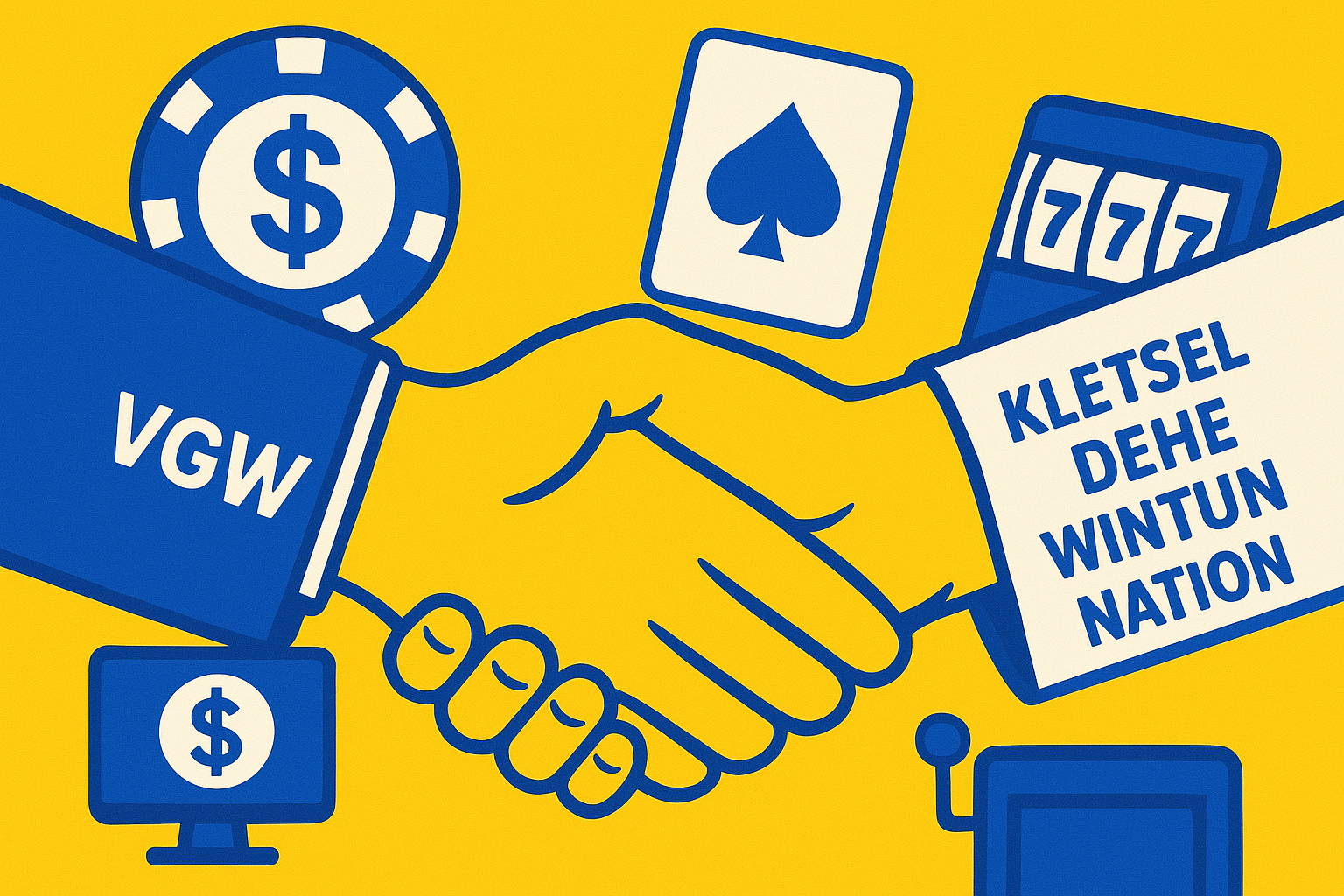
With that said, the Social Gaming Leadership Alliance, the preeminent sweeps advocacy group, has tried to change that, at least with its members, including VGW, Yellow Street Interactive (Pulsz), ARB Interactive (Modo.us), and B-Two Operations (McLuck). SGLA members are all 21-plus and must abide by certain responsible gaming and consumer safety practices.
Kirschner thinks there needs to be more of that intra-industry cooperation.
“My hope is that the players in this industry to an even greater extent than they are now are embracing a theory of two things,” he said. “One, that a rising tide still lifts all boats. I think there’s plenty of land to grab in this space. I think there’s plenty of innovation to be had, and these companies are still at a point where it is more beneficial to do that as part of a collective than to do it individually. And so I very much sound the horn and make the call to any companies that want to enhance that cooperation, even beyond what they’re doing today.
“And then beyond that, what I would continue to call for is those companies that do heed that call put forth their own set of standards. Whether that is on game innovation, where we think the lines may be drawn in certain states, or on, again, consumer protection, RG, AML, credit card usage, limiting, all sorts of things that as this industry grows and matures, it will need to be embraced and recognized in order for this industry to have that longevity and no longer just have a conversation about survival, but have much more exciting conversations about where they slot in the pecking order of the gaming ecosystem.”