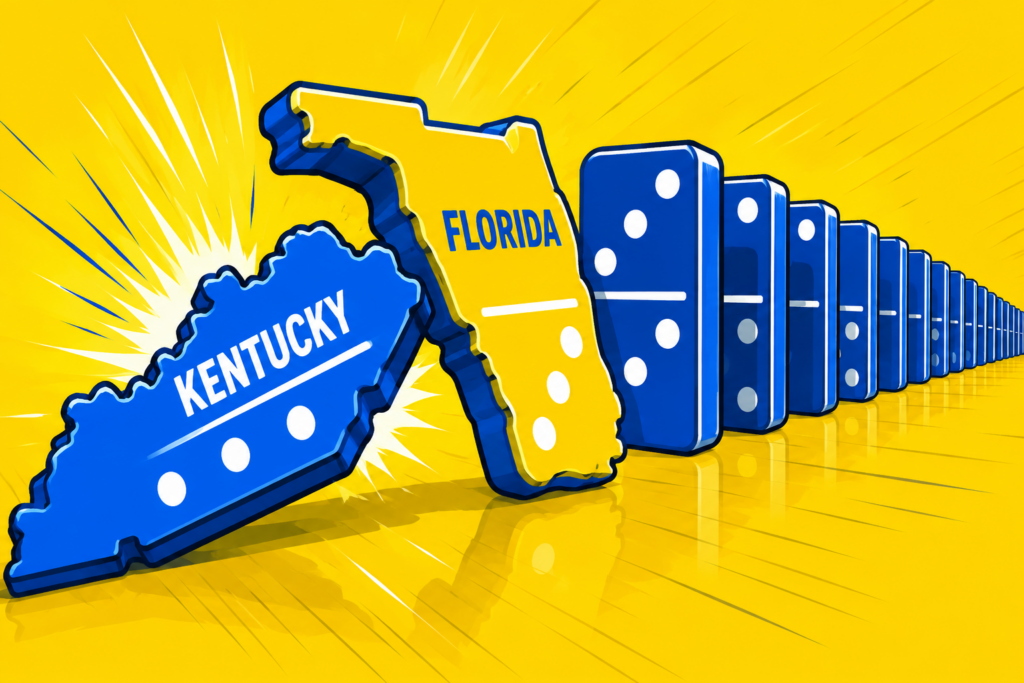
Numerous sections of the United States Code govern the operation of sweepstakes promotions across the country. Regardless, sweepstakes casino operators haven’t taken state attorneys general, gambling regulators, or governors to court arguing that their enforcement actions are invalid based on the concept of those federal laws preempting state-level restrictions, as the companies behind prediction markets are.
There are several legitimate reasons for this disparity between responses from prediction markets and sweepstakes casinos. The foremost of those reasons is that the framework of federal statutes concerning sweepstakes and the content of the laws governing prediction exchanges is vastly different in the ways that matter.
Federal laws governing sweepstakes in the US
Multiple sections of the US Code cover various aspects of sweepstakes promotions. In some cases, the language of the statute explicitly mentions sweepstakes, while in others, legal precedent has been established to apply the statutes’ language to sweepstakes.
- CAN-SPAM of 2003
- The Deceptive Mail Prevention and Enforcement Act of 1999
- The FTC Act of 1914
That isn’t a comprehensive list of all federal standards that may apply to sweepstakes depending on context. The crucial fact is that multiple federal agencies are responsible for enforcing these parts of the code.
That puts sweepstakes in sharp contrast with prediction markets from a legal perspective as Linda Goldstein, partner at CM Law, explains.
“There are several reasons for this disparity,” Goldstein commented. “The main reason for the disparity is that there is no other federal regulatory scheme that specifically governs sweepstakes casinos. The Deceptive Mail Prevention and Enforcement Act only applies to direct mail sweepstakes. CAN-SPAM applies only to emails and Section 5 of the FTC Act applies generally to deceptive or misleading advertising, not specifically to gambling or sweepstakes casinos. In short, there isn’t a federal agency that expressly governs sweepstakes casinos the way there is for prediction markets. The CFTC has a clear statutory mandate over derivates under the Commodities Exchange Act.”
One of the basic tenets of federalism in US law is that when federal law is insufficient to govern an aspect of society, state governments are free to fill those gaps. That’s a key concept in state governments’ influential actions regarding sweepstakes casinos.
Precedents establish states’ leverage over sweepstakes casino websites
Numerous significant court rulings such as Murphy v. NCAA in 2018 have established and strengthened the rights of states to regulate gaming activity within their borders. That’s an obstacle that sweepstakes casinos are facing in states like California, Maine, and New York, which have enacted laws explicitly banning casino-style online games that are based on dual-currency sweepstakes.
Unless and until Congress acts to establish a federal framework, that status quo will remain.
“Historically, sweepstakes and gambling have always been subject primarily to regulation under state gambling and lottery laws,” Goldstein explained. “While the laws vary by state, the gambling and lottery laws generally prohibit schemes where persons pay or risk something of value for the chance to win a prize and the states have been the primary enforcers of these laws. There are several federal laws that prohibit unlawful gambling, but their authority is narrower and in many cases the application of those laws depends on whether the underlying activity would be considered gambling under the applicable state laws.”
It simply comes down to Congress having been less explicit in its regulation of gambling and sweepstakes than it has of designated contract markets, which prediction market exchanges offer to people in the US.
“None of the federal agencies has the kind of direct product-level regulatory authority that the CFTC has over derivatives, which is how the prediction markets characterize their event contracts,” Goldstein added.
Positive development for sportsbooks has translated to bad news for sweepstakes casinos
Cases like Murphy v. NCAA, as well as existing federal statutes regarding gambling, enabled the current framework for regulated gambling in states that have opted for it. At the same time, a potentially unintended consequence was providing motivation for state governments to guard that framework.
“There is, however, another reason the states are so involved, particularly when it comes to event contracts on sporting events,” Goldstein continued. “There is now a comprehensive regulatory framework in place in numerous states that specifically govern sports betting. These state laws require that the operators be licensed and must pay money to the states based on the revenue generated. The states are reportedly losing a significant amount of revenue from sports betting as a result of prediction markets. An article in the New York Times indicated that a source estimated that states could be losing as much as $570 million in annual revenue.”
The same logic is behind states taking enforcement actions against sweepstakes casinos. While gaming regulators and state attorneys general have not mentioned any estimates of revenue they could consider lost, many of them like Louisana Attorney General Liz Murrill characterized sweepstakes casinos as violating consumer protection and gambling laws in the respective states.
The structure of sweepstakes casinos also complicates the possibility of operators making a federal preemption claim to protect their activities from enforcement on the state level.
Sweepstakes casinos’ gaming format complicates federal preemption, too
The same offerings of casino-style games that have drawn the ire of attorneys general, gaming regulators, and lawmakers across the US also further weaken any potential argument of federal preemption for sweepstakes casino operators.
“The sweepstakes casinos are designed to look like promotional sweepstakes and those are primarily subject to the various state laws,” Goldstein stated. “While sweepstakes casinos are online platforms that look and feel like real money casinos, they are structured to operate under sweepstakes laws rather than gambling. Sweepstakes violate state laws when there are all three elements of prize, chance, and consideration. The main theory of sweepstakes casinos is that there are no prizes because what you win—i.e., extended game play—has no value outside the game. They also offer free coins to play, which they argue eliminates consideration. There are legal nuances to those arguments, but they are all dependent on the language of the underlying state laws. For example, in Washington, the statute expressly defines extended game play as a prize while other state laws do not.”
Representatives of sweepstakes casinos have themselves acknowledged the appropriateness of state jurisdiction over their activity in two ways. The first has been by calling for states to group their platforms into regulated gambling systems rather than ban them.
For example, a bill that would call for a study into potentially regulating sweepstakes casinos in Tennessee has been praised by the Social Gaming Leadership Alliance (SGLA), a trade group for sweepstakes gaming companies. During a recent hearing on a sweepstakes ban bill in Minnesota, a representative of one such firm called for regulation of the industry instead as well.
The second way in which sweepstakes casinos are acknowledging state governments’ rights to dictate their behavior is by nearly universally pulling out of the various states that have taken enforcement actions against them. To date, none of these entities has attempted to challenge the validity of any cease-and-desist order or new law.
Sweepstakes casinos’ preemption arguments wouldn’t hold much water
Part of the reason that sweepstakes casinos have opted to alter their offerings or leave states altogether rather than raise challenges in court is a question of resources. While prediction markets have enjoyed significant investments from entities like the Intercontinental Exchange and New York Stock Exchange to shore up their legal defense funds, the same level of notable investment has not been put behind sweepstakes casinos.
Goldstein doesn’t think the federal preemption argument would get very far in court even if a sweepstakes casino did pony up the cash to make it, though.
“A federal preemption argument here would likely fail because there is no federal regulatory authority with clear and broad jurisdiction over casino sweepstakes as opposed to the CFTC, which has clear authority over derivatives,” Goldstein said. “The only issue for the prediction markets is how the event contracts are classified. If they are deemed to be derivatives, they are clearly under the jurisdiction of the CFTC. This issue is likely headed to the Supreme Court, particularly after the Third Circuit just ruled in favor of the prediction markets and held that Kalshi’s event contracts are swaps under the CEA (i.e., derivatives) and therefore fall within the exclusive jurisdiction of the CFTC.”
In simple terms, comparing prediction markets to sweepstakes casinos in terms of their ability to argue for federal preemption to protect their businesses isn’t really an apples-to-oranges comparison. It’s more like comparing apples to ball bearings.