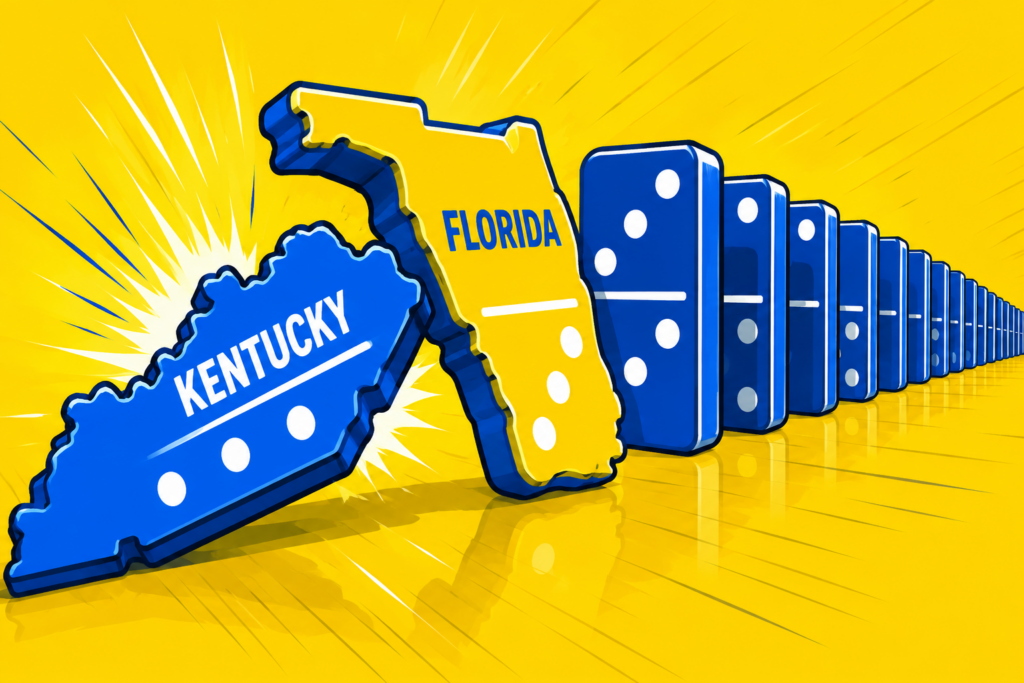
A bill that could classify sweepstakes gaming under the umbrella of racketeering in Louisiana is on the doorstep of completing its circuit through the state legislature.
House Bill 53 cleared the Legislative Bureau and was advanced to its third reading on Monday, meaning it could receive its third reading in the Senate as early as this week. Typically, after a bill’s third reading, it is voted upon by the full chamber.
Having already passed the House on March 30, if HB53 passes the Senate, it will be sent off to Gov. Jeff Landry for his signature or veto. HB53 would be the most unique bill to pass regarding sweeps casinos. Until now, all have outlawed online sweepstakes gaming by assigning it to the category of illegal online gambling.
HB53, however, would do something more drastic.
Taking things a step beyond traditional ban
HB53 would fold a handful of gambling-related crimes into Louisiana’s racketeering statutes, turning acts that are already illegal into offenses with much heavier criminal consequences. The bill lists several activities, including “gambling by computer” and “gambling by electronic sweepstakes device.”
You may think “gambling by electronic sweepstake device” is the crime that would target online sweeps casinos. But it likely isn’t. This line appears more directly aimed at in-person kiosks or terminals that run sweepstakes-style games.
It’s the “gambling by computer” that could cause problems for sweeps.
Gov. Landry and Attorney General Liz Murrill have already taken the position that using Sweeps Coins at sweepstakes casinos amounts to online gambling. If that interpretation holds, sweeps casinos could be labeled “gambling by computer” and, thus, be subject to racketeering charges.
Applying racketeering law to sweepstakes gaming would mark a significant escalation beyond the enforcement Louisiana has used so far — or any state, for that matter. Cease-and-desist letters (and there is a huge presence of those already in Louisiana) ultimately have limited force. Traditional bills carry more weight. But placing the industry under racketeering law would create an enforcement mechanism with more bite.
If it passes, HB53 could also bypass many of the debates that typically surround sweepstakes gaming (whether outcomes are based on skill or chance, whether the model technically qualifies as gambling, etc.) by treating the operation itself as illegal.
Of course, this potential future boils down to any court taking Landry and Murrill’s interpretations of state law as correct.
And, given who those two people are, they likely would.
However, there is another bill currently on the table in Louisiana that may more effectively classify sweepstakes casinos as “gambling by computer” — and it’s also progressing nicely.
HB883 would guarantee sweeps is considered racketeering
House Bill 883 is that bill.
And, after passing the House on April 14, it was assigned to its first Senate committee on Monday: the Committee on Judiciary B. No hearing has been scheduled yet.
Funnily enough, HB883 never actually mentions sweepstakes casinos.
Instead, it only targets a “dual-currency system of payment” and weaves that into its definition of illegal online gambling.
Under the new language, the bill classifies any online game, contest, or promotion that relies on two forms of currency (and allows players to trade that currency for prizes, cash, cash equivalents, or even opportunities to win them) and simulates casino gambling as illegal.
And here’s the most important part, in relation to HB53: HB883 specifically states that any such game will be considered “gambling by computer” under Louisiana law. And if HB53 passes, gambling by computer would be a racketeering crime.
This wording in HB883 is damning for sweeps casinos because it closely mirrors how most sweepstakes casinos operate. They typically use two types of virtual currency: Gold Coins and Sweeps Coins. Gold Coins are purchased and used strictly for gameplay, with no real-world redemption value. Sweeps Coins, on the other hand, can be redeemed for cash prizes.
That distinction between Gold Coins and Sweeps Coins is what has kept sweepstakes casinos out of the realm of illegality all these years until industry scrutiny ratcheted up in 2025.
Sweeps Coins aren’t sold directly. Players can get them for free through various methods, such as mail-in requests, daily rewards, or promotional bonuses tied to Gold Coin purchases. That “no purchase necessary” structure has long been central to arguments that these sites don’t constitute real-money online gambling.
But that interpretation has come under fire since 2025, as lawmakers, regulators, and Attorneys General in a growing number of states have begun treating the dual-currency model as functionally equivalent to real-money online gambling.
What other states still have legislative bans on the table?
Two other states are still considering bills in the 2026 legislative session that would outlaw sweeps casinos.
Minnesota Senate File 4474 has been on a fast track since getting filed in mid-March. On April 24, it will face its fourth committee hearing (Senate Finance Committee) before, if it passes the Finance Committee, presumably being presented to the full Senate.
There’s a bit of a time crunch for this bill, as Minnesota’s session ends on May 18 and SF4474 would still need to progress all the way through the House should it advance through a full Senate vote.
In Oklahoma, meanwhile, House Bill 1589 passed the Senate Judiciary and Public Safety Oversight Committee on April 14 and currently awaits its next step in the Senate; it already unanimously cleared the House on March 2. Like HB883 in Louisiana, HB1589 never makes reference to sweeps gaming — only focusing on banning the dual-currency system itself.
Oklahoma’s 2026 session doesn’t end until May 29, so there’s plenty of time here.
There’s also a bill in Washington, DC — Council Bill 260656 — introduced recently that would both ban sweeps casinos and legalize real-money online casinos. It is slated for a committee meeting on Tuesday and a public hearing on May 4. The Council of the District of Columbia meets year-round, so there’s not necessarily any timelines this bill needs to abide by in order to pass.