

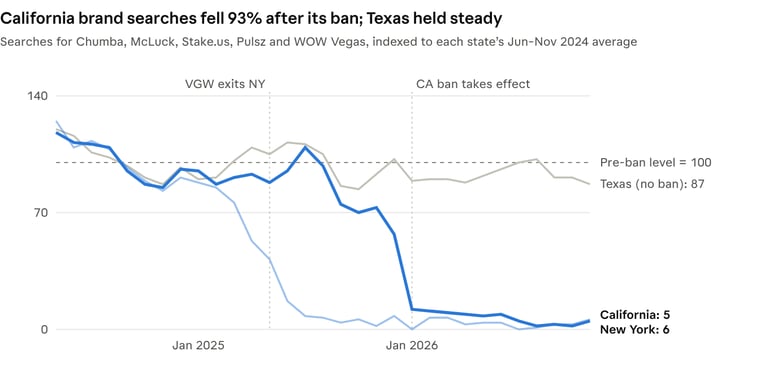
Nearly a year after California’s ban on dual-currency sweepstakes casinos took effect, searches there for major industry brands Chumba Casino, McLuck, Stake.us, Pulsz, and WOW Vegas are down 93% from 2024. In Texas, where nothing changed, they’ve slipped only 7%.
That’s according to an analysis of Google search data via Google Trends by Sweepsy in late November.
That same analysis indicated, at least based on search data, players in California aren’t flocking to offshore sites as a result of the ban. California searches for "crypto casino" jumped in April but were back near zero by fall.
Card Crush, the pioneer of the single-currency model that sprung up after the dual-currency bans in California and New York, has done better. Still, at its peak it drew less than a third of the search interest Chumba Casino alone had before the ban, and it's been slipping since May.
Let’s break down the analysis in detail.
California and New York vs. Texas
Assembly Bill 831, the landmark legislation that banned dual-currency gameplay in California, the largest and most important sweeps market, went into effect Jan. 1, 2026.
For the comparison, we took average monthly searches for the five brands listed above from February through October 2026, after California's ban took effect, and compared them with June through November 2024, well before operators started pulling out of California and New York.
In California, 2026 searches came in at about 7% of the 2024 level.
In New York, 4%.
In Texas, meanwhile, which has no ban, 2026 search volume is 93% of 2024 volume.
Why 2024 and not 2025? New York operators began leaving in spring 2025, so a 2025 starting point would already include part of New York's drop. For California, using summer 2025 as the starting point gives about the same result.
In both states, the decline started well before the law did. California searches started falling in September 2025, when the big platforms announced they'd be gone by Jan. 1. New York searches fell by half in spring 2025 as VGW and other operators pulled out roughly seven months before Gov. Kathy Hochul signed the ban in December.
(For what it’s worth, New Jersey doesn't have enough search volume for all five brands, but Chumba Casino searches there dropped to zero in August 2025 and haven't really come back.)
Where did the searches go?
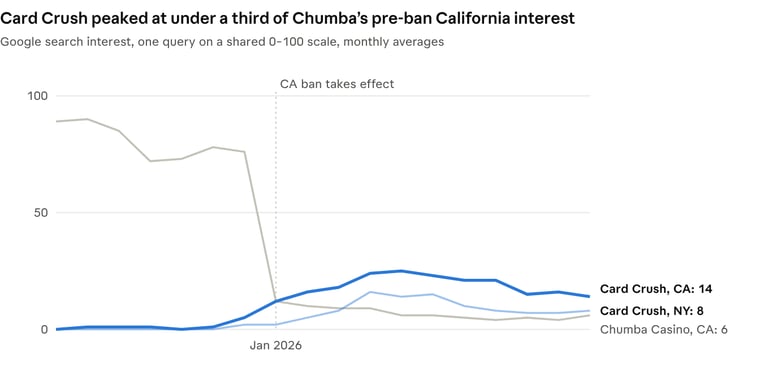
Card Crush is a good test of whether California players moved to a legal option or went offshore. Vision NL launched the single-currency platform on Dec. 29, 2025, two days before the California ban took effect.
(Quick note: The numbers in this section are Google Trends scores, which run from 0 to 100. These are not actual counts, but rather a representation of volume compared relative to the term's search peaks. In other words, a 0 does not literally mean zero searches were performed.)
Before the ban, Chumba scored between 72 and 90 a month.
Card Crush climbed for five months after launch and peaked at 25 in May, less than a third of Chumba's old level. It has since slipped to 14. In Texas, it scores between 0 and 7.
Searches for other potential destinations jumped for a month or two and then faded.
"Crypto casino" jumped from about 2 to 11 in April 2026, then fell back to 1 or 2 by fall.
"Online casino" rose from about 30 to 52 in March and 62 in April, then dropped to 26 by October, below its 2025 level.
What it means for 2027
This year's bans played out in a similar way.
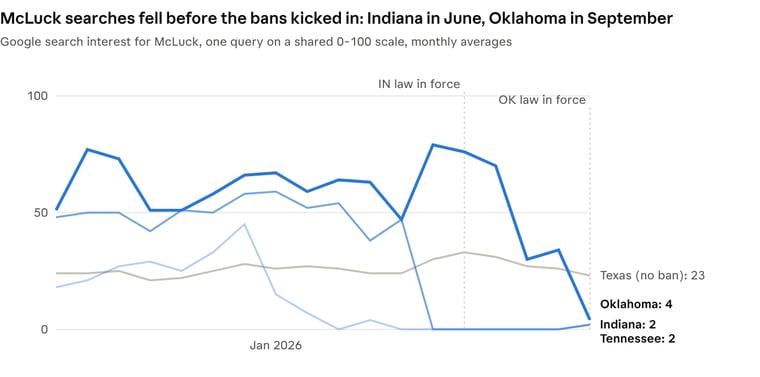
In Indiana, which was the first state to pass a sweeps ban in 2026, McLuck searches went from 47 in May to 0 in June, a month before House Bill 1052 took effect July 1.
In Tennessee, they dropped from 45 in December 2025 to 0 by March, after the attorney general's December crackdown and before the ban was signed that spring.
Oklahoma stayed near its highs through August, then fell to 30 in September and 4 in November, the month its law took effect.
More ban bills will be considered in 2027. Pennsylvania's House Bill 2801, pre-filed for the session that opens Jan. 5, would ban online sweepstakes games and allow fines up to $500,000. Wyoming's gaming committee is sponsoring a bill that would cover single-currency models too, which could put Card Crush at risk (in an albeit small market).
A bill that would legalize iGaming in Washington, D.C. has passed its initial committee stage — and the legislation would regulate sweeps providers as iGaming operators.
Why we tracked brand names instead of generic terms
We used brand names instead of generic terms like “sweepstakes casinos” for two main reasons.
First, there isn't enough volume at the state level for those broad terms.
Second, players more often search for the site they want to play on, like Chumba or McLuck. Brand searches are closer to what we wanted to measure: people trying to play.
How we measured it
All figures come from Google Trends, pulled Nov. 28, 2026, using weekly data from June 2024 through the week of Nov. 22, 2026, averaged by month.
Chumba Casino, McLuck, Stake.us, Pulsz and WOW Vegas, were searched together in one query per state. We summed the five and set each state's June-November 2024 average to 100, so the index shows change within a state, not size differences between states.
Where one term is compared across states (McLuck, Card Crush, Chumba Casino), all states are in the same query, so their values share one scale.
Trends measures search share, not players or revenue. Existing players who use an app or a bookmark don't search, and anyone using a VPN shows up in whatever state the VPN says.
In other words: A drop in searches is a good sign that new players stopped looking, but it doesn't prove existing players stopped playing.