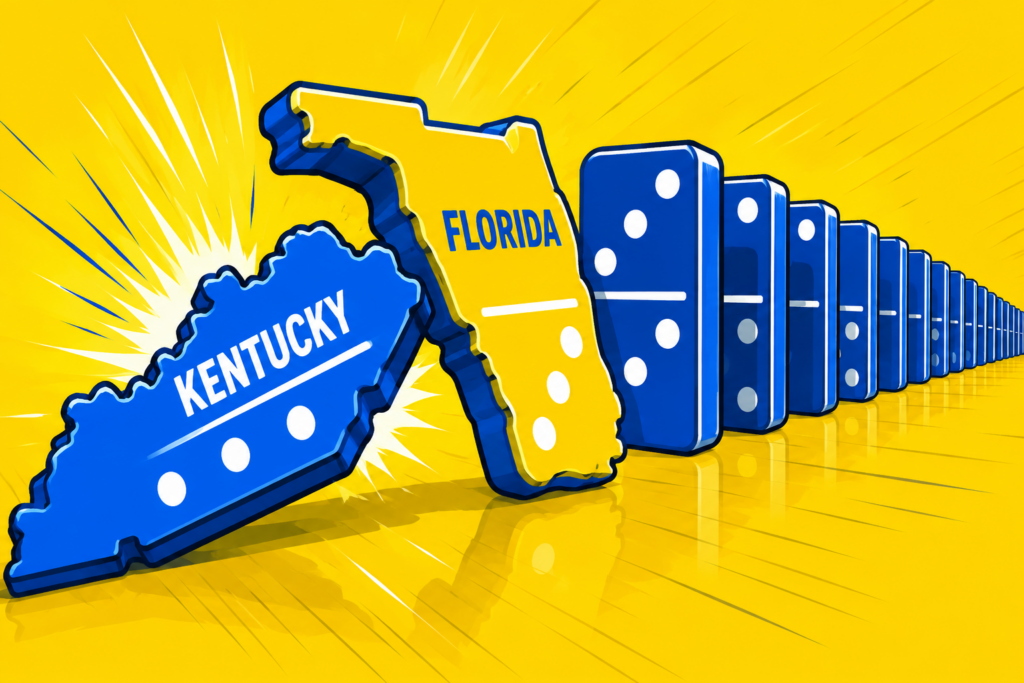
In the latest twist of an eventful 2026 for the sweepstakes casino industry, a lawmaker state that has already banned sweeps gaming has introduced a bill that clamps down even more on any remaining sweepstakes activity in the state.
On Tuesday, New York Sen. Samra Brouk filed Senate Bill 10092, also known as the No Gambling For Kids Act, which formally outlaws advertising any type of gambling or gambling-related activity to minors on “certain covered platforms and social media platforms.”
SB10092 was immediately referred to the Senate Internet and Technology Committee. New York’s 2026 legislative session ends on June 4, so, despite its late introduction, SB10092 has its fair share of time to progress through all necessary steps.
Sweeps casinos and social casinos in the same bucket?
SB10092 targets a wide range of online platforms.
In addition to sweepstakes casinos, SB10092 forbids advertising to minors (kids younger than 18 years old) for prediction markets, sports betting, online gambling, and “gaming-related” gambling, which encompasses essentially any platform where the minor would be able to make a purchase to benefit their performance or ranking in the game.
Or, as the bill defines them — games with an “add-on transaction” or “loot box” …
- “Add-on transaction” means a payment made to the operator of a covered platform of either money or an in-game proxy for money, including but not limited, to virtual currency which can be purchased with money that:
- (i) unlocks a feature of the product; or
- (ii) adds to or enhances the entertainment value of the product.
- “Loot box” means an add-on transaction to a covered platform that through a process of total or partial randomization:
- (i) unlocks a feature of the product;
- (ii) enhances the entertainment value of the product; or
- (iii) allows the user to make one or more additional add-on transactions that such user could not have made without making the first add-on transaction and the content of which is unknown to the user until after such user has made the first add-on transaction.
Notably, these classifications “may include a social gaming platform” — meaning the staunch sweeps opponents at Light & Wonder and other social casino companies will actually be targeted the same as sweeps platforms under SB10092.
And here’s what the bill says regarding what specifically is prohibited for advertising:
It shall be unlawful for the operator of a covered platform or a social media platform to display to a user a paid advertisement, sponsored content, influencer marketing, affiliate marketing, algorithmic promotion, targeted amplification or cross-platform promotional placements for a service that permits online gaming-related gambling, predictive market wagering, online sweepstakes gaming, sports-related gambling, and/or traditional online gambling unless such operator has reasonably determined that such user is not a minor in accordance with age determination and age assurance regulations promulgated by the attorney general pursuant to this section.
Ban from 2025 didn’t mention advertising
New York Gov. Kathy Hochul signed Senate Bill 5935 last December, officially outlawing sweepstakes casinos as part of a wave of significant bans that dominated 2025 in the sweeps industry, alongside California and New Jersey. Most sweeps casinos — or the notable ones, at least — have since left New York.
However, interestingly, nothing in SB5935 specifically mentioned advertising of sweepstakes casinos, much less advertising where minors would be able to see it. Instead, it focused its language on the definition of online sweepstakes games and their prohibition.
So, as a result, you could say SB10092 adds a second coat of paint to the restrictions levied against sweepstakes casinos in New York, folding those operators into a sweeping advertising ban to minors on social media and other related platforms.
A stronger definition of sweeps gaming?
SB10092 also includes what could be interpreted as a more stringent definition of what an online sweepstakes casino is.
Here’s the SB5935 definition from last year:
“Online sweepstakes game” shall mean any game, contest, or promotion that is available on the internet and/or accessible on a mobile phone, computer terminal, or similar access device, that utilizes a dual-currency system of payment allowing the player to exchange the currency for any cash prize, cash award or cash equivalents, or any chance to win any cash prize, cash award or cash equivalents, and simulates casino-style gaming, including but not limited to, slot machines, video poker, table games, lottery games, bingo, or sports wagering. The state gaming commission shall determine what constitutes a dual-currency system pursuant to this paragraph.
And here’s the definition in SB10092:
“Online sweepstakes gaming” means a game, contest, or promotion meeting all of the following conditions:
(i) available on the internet or accessible on a mobile phone, computer terminal, or similar device;
(ii) utilizes a dual-currency system of payment that allows a user to play or participate with direct consideration or indirect consideration, and for which the user playing or participating may become eligible for a prize, award, cash, or cash equivalents or a chance to win a prize, award, cash, or cash equivalents; and
(iii) simulates gambling, which, for purposes of this section, includes, but is not limited to, any of the following:
(A) slot machines;
(B) video poker;
(C) table games, including, but not limited to, blackjack, roulette, craps, and poker;
(D) lotteries;
(E) bingo;
(F) sports wagering; and
(G) awards cash or cash equivalents.
The 2025 definition is broader and written as a sweeping description. It focuses on games that use a dual-currency system tied to cash or cash-equivalent prizes and includes examples like slots, poker, and sports betting. However, it leaves key interpretations — especially what qualifies as a “dual-currency system” — to the State Gaming Commission. This makes it more flexible but also more dependent on regulatory discretion.
The 2026 definition is more detailed and structured as a multi-tier test, requiring that all conditions be met. It explicitly includes both direct and indirect consideration, making it harder for operators to avoid regulation through alternative payment models like subscriptions, single-currency, etc. It also expands prize language beyond just cash equivalents and more clearly defines what it means to “simulate gambling” through a structured list of game types.
Overall, it’s fair to say the 2026 definition is more precise and enforcement-oriented. It reduces ambiguity, closes potential loopholes, and may be easier for regulators or courts to apply consistently.