Of the five states to pass bills banning sweepstakes casinos in 2026, Oklahoma has the longest wait before Sweeps Coin gameplay officially must go offline.
Indiana and Maine’s bills are already law. Same with Tennessee’s. Louisiana’s bill became law on Aug. 1. But Oklahoma’s doesn’t until Nov. 1.
Still, even with the longest wait until its effective date, Oklahoma’s bill stands out because of the trend it represents: When tribal gaming interests decide to challenge the sweepstakes casino model, they are often difficult opponents to beat.
Tribal gaming is not just a casino industry. It is an established economic and political structure that has developed over decades through tribal-state compacts, federal recognition, and billions of dollars in economic activity. Sweepstakes casinos, meanwhile, are relatively new to the scene and are attempting to establish a regulatory foothold while staving off restrictions.
That imbalance was clear last year in California.
And it again became clear this year in Oklahoma.
How Oklahoma lawmakers rallied behind tribes, sweeps ban
Senate Bill 1589 effectively closed the door on any entity other than an Oklahoma gaming tribe from offering online gambling of any kind in the state, now or in the future. The bill specifically classified dual-currency gaming as online gambling.
In practical terms, the bill protected tribal exclusivity. If Oklahoma eventually legalizes online casino gaming, the state’s tribes will control that market.
That fact is likely why SB1589 coasted through the legislature — featuring a unanimous approval in the Senate — before Gov. Kevin Stitt vetoed it. And then the fact that lawmakers overrode Stitt’s veto made the victory even more notable: They chose to side with tribal gaming interests and move forward without the governor’s approval.
That shows the level of political influence tribal gaming interests can have when an issue is directly connected to their economic interests.
California provided that emphatically last year.
Similarities between Oklahoma and California
In 2025, California lawmakers passed Assembly Bill 831, which banned Sweeps Coin gameplay in the state. The bill was almost entirely driven by the state’s gaming tribes, and its passage was seen as a major victory for tribes and a major warning sign for sweepstakes casinos.
The similarities between California and Oklahoma are difficult to ignore.
California has the largest tribal gaming market in the United States, generating billions of dollars annually. Those revenues support tribal governments and help fund healthcare programs, education initiatives, infrastructure improvements, and employment opportunities.
Oklahoma’s tribal gaming industry is similarly large, with dozens of federally recognized tribes operating more than 100 gaming facilities. Tribal casinos there also generate billions in economic activity and have become a major component of the state’s economy.
Those economic contributions translate into political influence.
The lobbying power of gaming tribes
For lawmakers, tribes are not simply industry stakeholders. They are longstanding economic partners with deep relationships throughout state government, and have spent years building political networks.
Sweepstakes casino operators are in a different boat.
Many are newer businesses without decades of state-level relationships or established political influence. They also operate within a complicated legal landscape where explaining their business model to lawmakers can be difficult.
The dual-currency system used by many sweepstakes casinos — where players play with non-redeemable Gold Coins and redeemable Sweeps Coins — is at the heart of the recent wave of scrutiny on sweeps casinos, with critics arguing playing with Sweeps Coins is too similar to gambling with real money.
That ambiguity creates a difficult lobbying environment, especially against tribal interests.
Where may this trend continue?
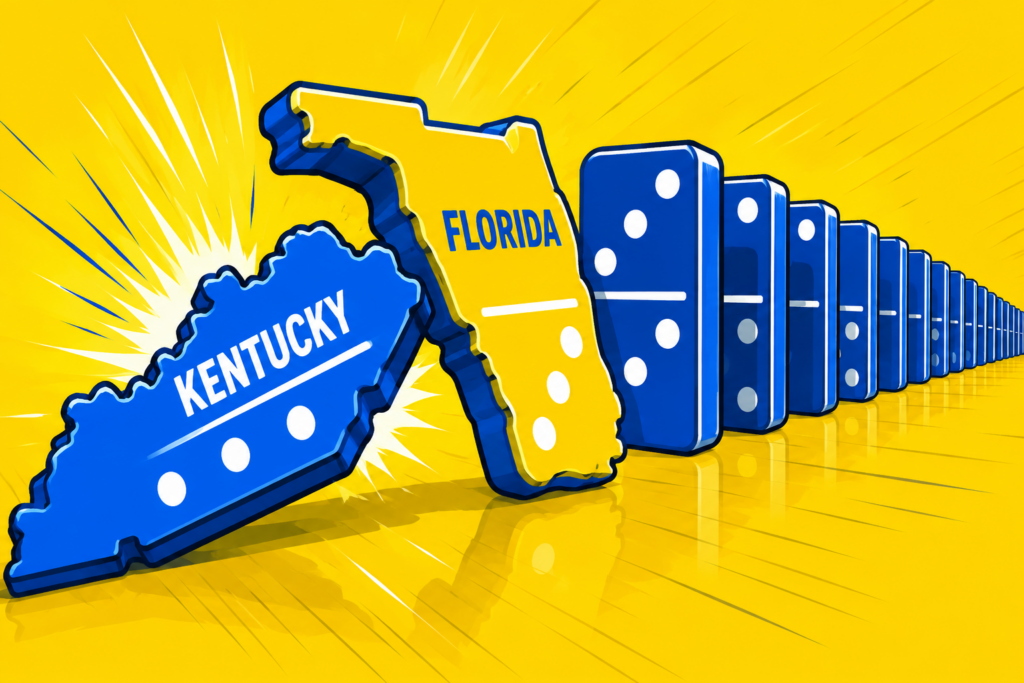
Florida and Arizona are two states that stand out as potential future battlegrounds.
Florida’s gaming market is heavily influenced by the Seminole Tribe, which operates the Hard Rock brand and has become one of the most powerful tribal gaming organizations in the country. The tribe’s gaming operations, combined with its sports betting agreement with the state, have given it significant influence over Florida’s gambling landscape.
However, despite speculation that Florida could become another target for dual-currency restrictions, the state did not pass any legislation in 2026 aimed at sweepstakes casinos.
That suggests sweepstakes casinos may not currently represent a top priority for Florida’s tribal gaming interests — though that could change if sweeps operators expand further or begin competing more directly with future online gaming plans.
In Arizona, meanwhile, there is a large tribal gaming presence and the state’s expansion into sports betting was also structured around tribes. While lawmakers didn’t pass a sweeps ban during the 2026 session, the state’s gaming regulator has been among the country’s most active when it comes to targeting sweeps operators through cease-and-desist orders.
Whether that regulatory activity develops into broader legislative action remains to be seen.
It also remains to be seen how much of a priority combatting sweeps casinos is in 2027 and beyond as prediction markets platforms become the focus of gaming tribes’ lobbying efforts around the country.