

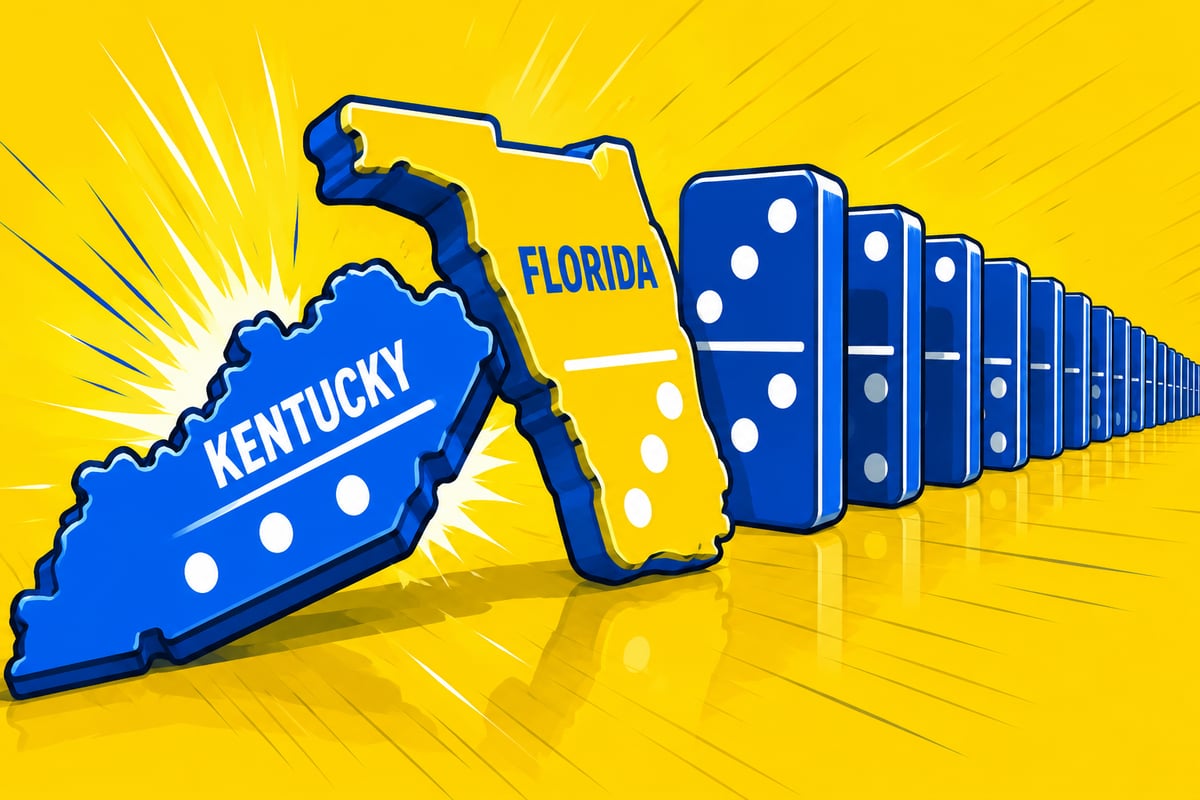
Kentucky and Florida opened up a new chapter of the sweepstakes casino enforcement playbook these past couple months, as the Attorney General’s offices in both states filed lawsuits against sweeps operators — VGW in both states, and also Stake in Florida.
And the growing sentiment is they might not be the only states to go that route.
One prominent stakeholder on the anti-sweeps side of this debate has gone as far as to make public comments regarding the potential of more of these types of lawsuits brewing.
A biased perspective, yes, but also proven to be accurate
F. Steven DiMasi is the Senior Vice President of Global Government Affairs and Business Development at Light & Wonder, a games provider that services much of the real-money iGaming industry and also has a robust social gaming arm in its SciPlay division.
Light & Wonder is one of the staunchest opponents of sweeps casinos, and DiMasi and Howard Glaser, the company’s Global Head of Government Affairs and Legislative Counsel, have long been the company’s anti-sweeps voices on platforms such as LinkedIn.
They are inherently biased, just as any on the pro-sweeps side of the debate are as well.
However, they are also well-connected in legislative and regulatory circles, and their LinkedIn premonitions often turn out to have at least a measure of truth to them.
So what DiMasi has posted on LinkedIn recently warrants attention.
In response to Florida Attorney General Jason Uthmeier filing his complaints against VGW and Stake on Aug. 19, DiMasi posted: “I wonder if any additional states will file litigation this year…likely so.”
Later, following up on that post, DiMasi also added, “I would not be surprised if more sweeps companies pivot to prediction markets…” — likely referring to the news of Fliff, the leader in the sweeps sportsbook space, applying to become a Futures Commission Merchant with the National Futures Association.
Onyx Odds and Rebet, other sweeps sportsbooks, have also applied to become prediction markets platforms. And ProphetX, a former sweeps sportsbook, switched over to the predictions space after getting its license from the Commodity Futures Trading Commission in June.
The next version of sweeps casino enforcement?
Until Uthmeier in Florida and Kentucky Attorney General Russell Coleman changed the playbook this summer, states attempting to restrict sweeps casinos in their jurisdictions went about it in predominantly one of two ways:
- Legislative bans
- Cease-and-desist orders
The legislative bans are, for the most part, effective. Yes, you’ll get a handful of murky sites sticking around despite a new law going into effect, but the bans usually rid a market of dual-currency sweepstakes casinos. Of course, these operators have now created a myriad of different gaming models that aren’t restricted by dual-currency bans, so even the effectiveness of modern legislation can be somewhat called into question these days.
(The bans in Louisiana are a different beast, as new laws in that state classify offering dual-currency sweepstakes gaming as a racketeering crime, making the market very off-limits.)
Cease-and-desists, on the other hand, are hit and miss.
Upon receiving cease-and-desists, some operators comply immediately.
Some take a long time and need to get nudged again.
And some ignore them entirely.
So, by an Attorney General taking the operator straight to court instead of threatening to go to court via a cease-and-desist, operators are forced to respond in at least some way. Either: We’re going to challenge this, or we’ll leave to avoid a costly legal battle.
Put differently: Is fighting the case worth the cost, or is leaving the market the better business move?
In this sense, Attorney General lawsuits can be seen as a much, much stronger version of a cease-and-desist.
And DiMasi thinks we’ll see more in the coming months.