This past week has seen multiple key legislative victories for sweepstakes casinos as, across three states where sweeps operators faced threats of bans, the clock simply ran out.
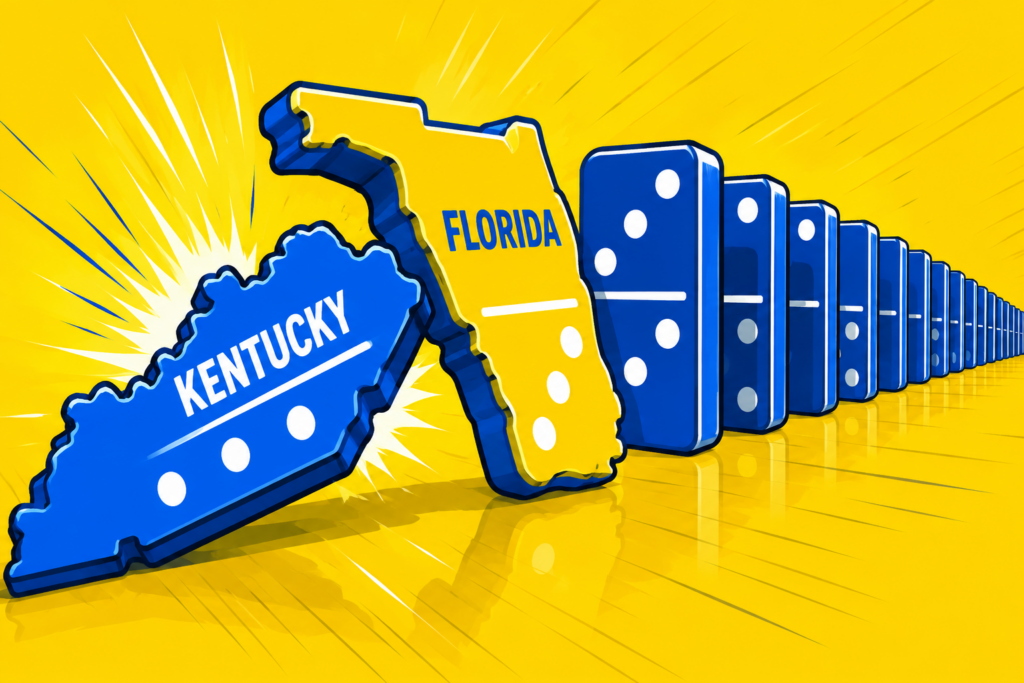
Bills in Virginia and Florida failed to advance before their respective states’ 2026 legislative sessions ended. And a committee in Massachusetts punted that state’s iGaming and sweeps ban bill until 2027 at the earliest. Those three states join Mississippi as the quartet of markets where legislative efforts to outlaw sweeps casinos in 2026 didn’t pan out.
Plus, legislation in Maryland is running out of time.
Virginia: No iGaming means no sweeps casino ban
In Virginia, lawmakers wrapped up their 2026 session on March 14 without resolving one of the most closely watched proposals. A conference committee was formed to iron out differences between Senate Bill 118 and House Bill 161 — bills that would have simultaneously authorized real-money iGaming and eliminated online sweepstakes casinos. But that committee failed to report anything to the full chambers for approval before adjournment, so the measures failed.
However, Virginia lawmakers have the option to carry 2026 bills into the 2027 session, and that’s exactly what could happen here. Not only can the iGaming framework be revived in 2027, but a separate bill — Senate Bill 579, which targets sweepstakes casinos without tying them to broader iGaming legalization — has already been approved for consideration in 2027 via a vote from the Courts of Justice in February.
Still, a win is a win for sweeps casinos. Now, in Virginia, nothing would take effect on the legislative front until late 2027 at the earliest. For operators, that creates a meaningful buffer, with lots of revenue to be made.
Of course, regulators and the Attorney General’s office could still attempt to rein in sweepstakes casinos through cease-and-desist letters. But those lack the teeth of a passed law.
Florida: Time ran out to approve House amendments
A similar story unfolded in Florida. There, Senate Bill 1580 successfully moved through both chambers of the legislature. The complication came because the House approved an amended version of the bill, and the Senate never had the opportunity to review and adopt those changes before the March 13 deadline.
Without agreement between the chambers, the bill stalled out and ultimately failed.
The implications of SB1580 were a matter of debate. The bill would have added “internet gambling” into Florida statutes and included “thing of value” as something that could be wagered illegally on internet gambling, in addition to money.
Could some lawyers have argued “thing of value” included Sweeps Coins? Perhaps.
For now, though, the debate is academic. With SB1580 off the table, no new legislative restrictions on sweepstakes casinos are coming in Florida in 2026. Enforcement activity is happening at a limited scale via cease-and-desists from the Attorney General.
Massachusetts: Let’s punt this to next year
In Massachusetts, the outcome was less dramatic but just as much of a sweeps win.
On March 16, the Joint Committee on Economic Development and Emerging Technologies opted to send House Bill 4431 to study. In legislative terms, that simply means the bill is done for the current session, but it leaves the door open for future consideration.
HB4431 would have legalized real-money online casinos while shutting down sweepstakes casinos. But the bill ran into significant resistance, including from the state Treasurer. That resistance won out.
That significant resistance makes attempts to legalize iGaming in the near future feel like futile attempts. So, if lawmakers are serious about banning sweeps, they may consider standalone sweeps bans in the 2027 session instead of attaching those provisions to iGaming bills.
For now, the state remains accessible to sweepstakes casinos.
Maryland: March 23 crossover deadline looms
Meanwhile, in Maryland, one bill is still kicking, but its prognosis isn’t good.
Earlier in the session, lawmakers introduced House Bill 295 and Senate Bill 112 — two bills that also combined iGaming legalization with a ban on sweepstakes casinos. Both bills, however, have been dormant since mid-January.
Bills must pass out of their originating chamber by March 23, which is also known as a crossover deadline. That doesn’t leave much time for the bills to finish their committee stages and get approval from their full originating chamber, so neither bill feels likely to advance.
More recently, lawmakers have taken a different approach. Senate Bill 652 and its companion, House Bill 1226, fold sweepstakes gaming into the definition of illegal online gambling and make no attempt to legalize iGaming. SB652 has gained some traction, including a hearing before the Senate Budget and Taxation Committee on March 11.
Even so, the bill hasn’t advanced beyond that initial step, and it’s unclear whether it will move before the crossover deadline. If it doesn’t, Maryland will once again fall short of passing a bill banning sweepstakes casinos — just like last year.
However, Maryland has still established itself as a sweeps-restrictive market. It has a hefty presence of cease-and-desist orders against sweeps operators.
Still, from a legislative standpoint, the absence of a new law would still represent a win, or at least a reprieve, for the industry.