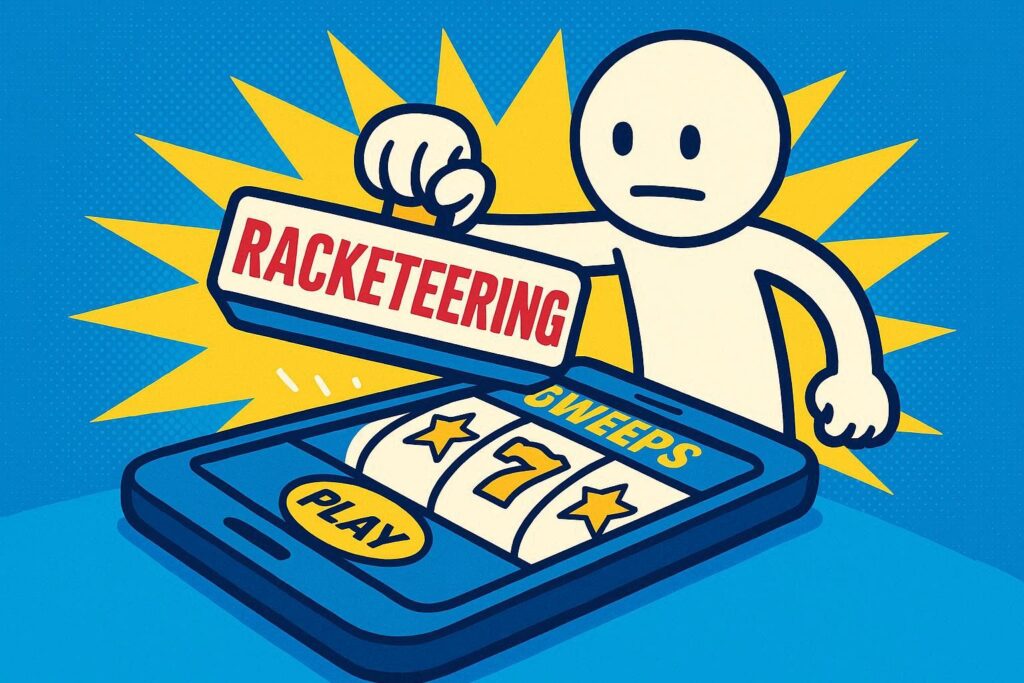
Maine lawmakers are wasting little time in 2026 to deliberate over a proposed bill banning Sweeps Coin gameplay in their state.
Legislative Document 2007, after getting pre-filed in early December, has already been scheduled for its first hearing before the Joint Veterans And Legal Affairs Committee at 10 a.m. local time on Jan. 14 — just a week after the state’s legislative session begins on Jan. 7.
It will be the first hearing for a sweeps ban bill in the 2026 legislative session. So far, legislation banning Sweeps Coin gameplay has been filed in Maine, Florida, and Indiana, and one in Massachusetts (that would also launch real-money iGaming) is carrying over into 2026, the second of a two-year legislative cycle in that state.
This initial group of proposed bans on sweeps casinos follows in the wake of five states — California, New York, New Jersey, Connecticut, and Montana — passing such bills in 2025.
Maine’s bill outlines the details of Sweeps Coin gameplay
Maine’s bill is unique among those introduced and/or passed in 2025 and 2026 so far.
LD2007 focuses less on broad prohibitions and more on dissecting how sweepstakes platforms actually operate. The bill drills into the dual-currency structure itself, arguing that operators design their systems to funnel players toward buying packages of Gold Coins that conveniently include Sweeps Coins.
While similar legislation elsewhere has targeted dual-currency gaming in broad strokes, Maine’s approach is more specific. The bill lays out the process step by step: Players purchase Gold Coins, which have no cash value, and receive a handful of Sweeps Coins, which can be redeemed for cash.
LD2007 labels this arrangement a “dual-currency system of payment,” describing it as a setup that prevents users from directly buying anything redeemable for cash while at the same time encouraging them to buy non-redeemable items (Gold Coins) in order to get a currency that can be cashed out (Sweeps Coins).
The legislation then turns to Sweeps Coins themselves, categorizing them as indirect consideration:
“[A token that is] provided for free through a promotion or bonus or with the purchase of a related product, service or activity; and … may be exchanged for a prize, award, cash or cash equivalents or a chance to win a prize, award, cash or cash equivalents.”
Like the sweeps ban bill passed this year in New York, LD2007 grants the state’s regulatory agency — the Maine Gambling Control Unit — sole authority to decide what qualifies as a dual-currency gaming system. That power would allow regulators to scrutinize not just today’s sweepstakes models, but any future variations operators might roll out — including rebranded or restructured offerings like the recently launched Card Crush platform, which pairs an RPG card gaming model with casino-style gaming also included.
Anti-sweeps climate exists in Maine
If the sentiment previously shared by the MGCU is shared by Maine lawmakers, we’d give LD2007 pretty good chances of passing this session, which, for Maine, ends in April.
Back in June, the MGCU released a public statement warning residents about “illegal interactive gaming (‘iGaming’) websites and applications that may be currently operating in the State” — and it included sweepstakes casinos in that group.
“Despite the legality of online advance deposit wagering, fantasy contests and sports wagering, online casino games like slots, blackjack, and roulette for real money remain strictly prohibited in the State,” the MGCU statement read. “Numerous unregulated entities continue to target Maine residents, offering illicit iGaming opportunities. These operations, based out of state and often out of the country, include sites that may appear legitimate but lack any regulatory oversight in Maine.
“Examples of such unlicensed platforms may include, but are not limited to, certain ‘sweepstakes’ or ‘social casino’ sites that offer real-money payouts, coin-titled substitutes, dual-currency systems, material prizes or gift cards.
“The Gambling Control Unit wants to make it very clear: no online casino, iGaming, or sweepstakes site is licensed by the Gambling Control Unit.”
The “coin-tutled substitutes” and “dual-currency systems” language is a direct callout against the Gold Coins/Sweeps Coins gaming model used by today’s sweepstakes casinos.
Consequently, the Social Gaming Leadership Alliance quickly released its own statement in response, pushing back against categorizing sweeps casinos in the same bucket as sites like Bovada and MyBookie.
“Unlike the offshore gambling sites referenced in the statement, SPGA members operate legally within the U.S., pay appropriate taxes, and follow a strict code of conduct to ensure consumer protection and fair play,” an SPGA spokesperson said in the statement.
“It’s disheartening to see this continued conflation of lawful sweepstakes promotions with unregulated gambling, particularly in the absence of any evidence of consumer harm. We welcome the opportunity to engage with Maine officials in a constructive dialogue to clarify how these platforms operate, the legal principles they follow, and the safeguards in place to ensure they serve the public responsibly.”
House Industries & Professional Activities Subcommittee for Florida’s bill
Meanwhile, Florida’s pre-filed sweeps ban bill, House Bill 591, has been assigned its initial committee: House Industries & Professional Activities Subcommittee. That will be the bill’s first hurdle to cross after Florida’s legislative session begins on Jan. 13.
HB591 is an expansive, 86-page overhaul of the state’s gaming laws, touching nearly every corner of regulated gambling. The bill carries political weight thanks to the support of the Seminole Tribe of Florida, the operator behind Hard Rock International and the state’s exclusive partner for legal online sports betting under the existing gaming compact.
Interestingly, the bill never calls out sweepstakes casinos by name.
In fact, neither “sweepstakes” nor “sweeps” appears anywhere in the language.
Instead, HB591 widens the state’s definition of illegal online gambling. Under the revised language, any internet-accessible game that simulates traditional casino play and awards money or “any other thing of value” based on chance would be banned unless offered by the Seminole Tribe and authorized through the compact. The definition covers any type of gaming that “simulates casino-style gaming, including, but not limited to, slot machines, video poker, and table games.”
So, if Sweeps Coins are deemed by Florida lawmakers to be a “thing of value,” Sweeps Coin gaming at sweepstakes casinos could fall squarely within the state’s ban on unauthorized online gambling, even without “sweepstakes gaming” ever being mentioned explicitly.
Florida’s 2026 legislative session ends in mid-March. Lawmakers filed two separate sweeps ban bills in the 2025 session, but neither passed.