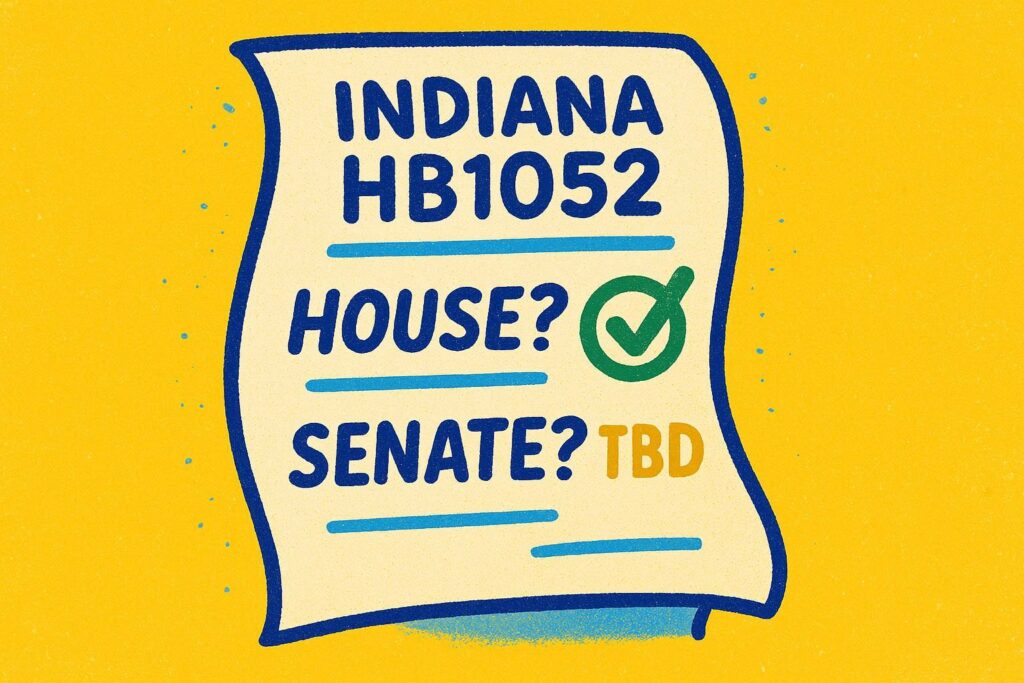
On Tuesday, Indiana’s House Public Policy Committee heard testimony on House Bill 1052, which makes changes to the state’s governance and regulation of gambling — including the ban of dual-currency sweepstakes casinos.
HB1052 was spearheaded by Rep. Ethan Manning.
‘We are losing revenue’ to ‘unregulated online systems’
Nate Friend, Chairman of Indiana State Gaming Commission, testified on why the agency has determined that it would be in the interest of the public to ban sweepstakes casinos.
“Coins have a monetary value,” Friend said. “You can redeem Sweeps Coins for cash or prizes once you meet the casino’s minimum redemption limit. Notably, you cannot purchase Sweeps Coins. Instead, they are awarded in promotions or included as a free add-on Gold Coin package purchases. They are essentially offering a form of gambling with no regulation, licensing, or taxation.”
“While consumers can play for free, they can also spend real money on the chance to earn cash and prizes through casino-style gameplay. Regardless of the monetary aspect, consumers are participating in these activities without the protections that regulated gambling offers, such as self-exclusion programs, independent product testing to ensure fairness, robust fraud detection, and age verification, financial and background checks on operators.”
Friend said this is a consumer protection issue that states across the country are working to solve by whatever means are available to them.
“Multiple states have explicitly banned sweepstakes,” he said. “States have made clear that their existing laws prohibit them. California, Connecticut, Montana, New Jersey, Washington, New York, Nevada, Louisiana, and Idaho. In addition, Indiana is one of nine states tackling this issue during the 2025-2026 legislative session along with Maine, Arkansas, Maryland, Mississippi, Florida, Illinois, Ohio, and Massachusetts.”
Added Rep. Manning: “I think we can pretty easily see that we are losing revenue at our regulated casinos because of the unregulated online systems.”
But one lawmaker asks: Why not tax it instead?
Rep. Steve Bartels discussed proposed amendment 6, which would just apply to sweepstakes casinos. Ultimately, the amendment calls for regulation of sweeps gaming.
“It still can stay in the sweepstake statute,” Bartels said. “We can start making money off it. We can start protecting citizens. We can do the age verification. We can make sure that they’re not advertising incorrectly or trying to target kids or people under 21.
“We’re talking about this amendment setting limits requiring employee training. We’re making sure there’s more than one layer of authorization. Geolocation is in this amendment. We’re making sure there’s privacy and protection for financial information and personal identifications and we’re making sure the prizes are regulated in a 48-hour period paid out.”
The amendment also provides civil penalties for non-compliance.
“If we don’t pass the prohibition, then we’re effectively saying we’re OK with the sweepstakes casinos continuing to operate as they are today,” Manning said. “Even though this legislature has been unable to pass iGaming and make that policy statement, we’re making essentially the same policy statement in reverse.”
Rep. Bartels was one of two committee members open to regulation over a ban. The other was Rep. Jim Lucas.
“I don’t think it’s right that an industry found a way to work within the boundaries of the law, and just because we don’t have our ducks in a row to legislate these industries and regulate them, we should punish them by outright banning them,” Lucas said. “It’s incumbent upon us to find a way to make this work, because I don’t think we should be in the business of picking winners and losers.”
Industry warns a ban won’t stop the problem
Sean Ostow, Managing Director of the Social Gaming Leadership Alliance, testified in support of the regulation that Bartels suggested in amendment six.
“The partner companies within the SGLA have already established a regime of strong consumer protections, mandatory age 21-plus responsible social gameplay tools, advertising standards, geolocation, and many other trust and safety provisions that pretty much mirror what’s already happening in the regulated market in Indiana,” Ostrow said. “If HB1052 were passed, I think the outcome is pretty predictable. The law-abiding operators are going to leave the state, but the bad operators will be able to stay. They’ll continue to prey on unsuspecting Indiana consumers.”
Ostrow noted the revenue that this would bring in.
“Currently, it’s a digital service that is not taxed,” he said. “If it were to be taxed, which is part of the proposal of Representative Bartel’s amendment, it would generate upwards of $22 million in new annual revenue. That’s a combination of sales tax on the purchases as well as an operator registration tax or registration fee.”
Dan Marks, Chief Financial Officer at ARB Interactive, which owns Modo.us, also spoke against banning the bill outright.
“While a majority of our players never make it an in-app purchase to enhance their playing, those that do can be rewarded with sweepstakes play and completely free,” Marks said.
“Alternative methods of entry are always available to enter the sweepstakes, including the old standby postcards for which we receive tens of thousands every month. Sweepstakes have a long history as a viable marketing tool that operates within well-established laws of each state and because we appreciate the demand from customers for sweepstake promotions, we acquired Publishers Clearinghouse last summer.
“We are meeting clear consumer demand for social plus games, but ARB takes player protection very seriously. As tech evolves, we continue to spend significant resources on age and ID verification software to prevent fraud and anti-money laundering, as well as to ensure only legal age players, and that’s 21-plus on our site, engage in sweepstakes play and only under the state laws in which they’re located.”
He noted the operators that may be of concern aren’t located in the U.S.
“They aren’t engaging with you to find a solution to protect customers, and they will continue to operate even if this bill is passed,” Marks said.
ARB believes that HB1052 is an overly broad attempt to protect consumers, but to some extent it is throwing the baby out with the bathwater.
“You have many reputable companies like ARB that have demonstrated a strong commitment to complying with Indiana state laws and ensuring that consumers are protected,” Marks said. “But if this bill passes and legitimate companies like ours are forced to exit, consumer demand will still remain and our players will simply drift to those offshore sites that have no compunction about operating legally, allowing miners to participate and not paying out legitimate prizes.”