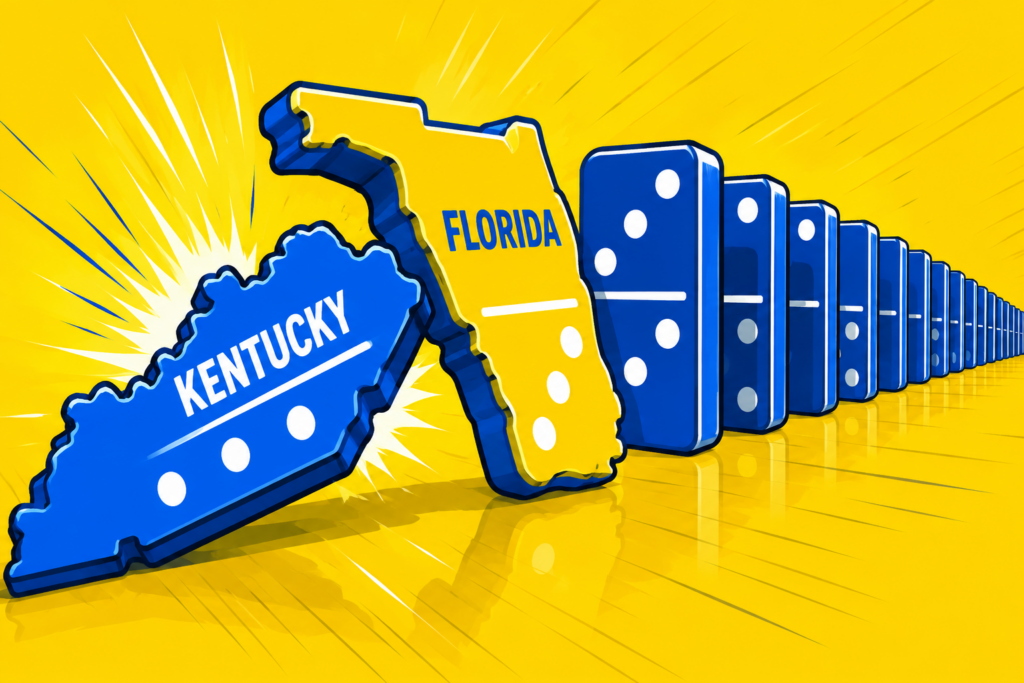
This will be a busy few weeks for discussions on the future of online sweepstakes gaming.
Three bills that would ban Sweeps Coin gameplay at sweepstakes casinos will have hearings between now and the first week of February.
Indiana House Bill 1052 will have its second hearing with the House Public Policy Committee at 8:30 a.m. local time on Jan. 22. (It was actually supposed to also have a hearing on Jan. 20, but that hearing was canceled.)
Then, Maryland’s twin sweeps ban bills — Senate Bill 112 and House Bill 295 — have hearings currently scheduled: SB112 is set for a hearing before the Senate Budget and Taxation Committee on Jan. 28 at 1 p.m. local time, while HB295 will be heard by the House Ways and Means Committee on Feb. 5 at 1 p.m.
Why Indiana is a battle to watch
Many in and around the sweeps industry will be tuned into the Indiana hearing on Thursday, as HB1052 has become somewhat of a battleground piece of legislation where it feels like both sides will have a say in the final outcome.
Comments from the state regulator’s general counsel created a legal foothold sweeps operators can rely on in Indiana — and potentially in other states with similar laws.
At the initial hearing on HB1052 on Jan. 6, Natalie Huffman, general counsel for the Indiana Gaming Commission, was asked whether sweepstakes gaming is currently prohibited under Indiana law.
“It’s nuanced but we don’t think so,” she said. “So, in other states, they think their gambling laws are written in a way that is able to be used against these online casinos, but I don’t think (with) the way that our gambling laws are written we can move forward with sending a cease-and-desist letter in good faith based on current law.
“The multi-currency model is what allows it to operate outside our current regulatory scheme.”
That statement effectively signals that sweeps casinos can continue offering Sweeps Coin play in Indiana without interruption while HB1052 advances through the legislative process. Also, it bolsters operators’ broader argument that their models are lawful in markets whose gambling laws resemble Indiana’s.
Indiana law defines gambling as follows:
“Gambling” means risking money or other property for gain, contingent in whole or in part upon lot, chance, or the operation of a gambling device …
Per Huffman, the dual-currency structure does not fall within the “money or other property for gain” standard.
That reading may also help operators counter arguments in other states where gambling is defined using “thing of value” language, raising the question of whether that phrasing is materially different from Indiana’s “property for gain” wording.
Resistance to a ban is also coming from within the legislature itself. Several lawmakers — particularly two members of the House Public Policy Committee — have pushed back against banning sweepstakes gaming rather than regulating it.
Rep. Steve Bartels has proposed an amendment that would establish a regulatory framework instead of a ban. His proposal would impose a $100,000 licensing fee covering five years and place oversight under the Attorney General’s office.
During the Jan. 6 hearing, Bartels questioned the logic behind banning the industry.
“We keep saying there’s no violation of our current law and it’s odd that we have an agency wishing to pass iLotto owned by a private company outside the state of Indiana that now most of these sweepstakes are outside Indiana — but we’re going to ban them without trying to regulate them first?” he said. “I think we’re doing a knee-jerk reaction based on potential competition with our own state agencies and I think we need to seriously step back and say, ‘Wait a minute. Is this what we’re going to do? This is the first time hearing about this and we’re going to ban this?’
“They’re not violating any laws. But maybe we need to regulate them.”
Rep. Jim Lucas echoed that sentiment more forcefully, rejecting the idea of an outright ban:
“(Sweeps casinos have) been doing business for well over a decade,” he said. “They provide a service that hundreds of thousands of Hoosiers are enjoying, and they are operating within the law. And it’s incumbent upon us to find a way to make this work because we obviously have other industries that we have molded ourselves around lawfully and I don’t think we should be in the business of picking winners and losers — as we are doing right now with iGaming.
“So until we can find a way to regulate this industry, I am 100% against just outright banning them.”
Additional committee members — Reps. Cory Criswell, Peggy Mayfield, and Matt Lehman — also voiced reservations about banning sweepstakes gaming via HB1052.
It’s about ‘multiple currency systems’ in Maryland
As for the Maryland bills, they are notable for the way they frame the issue. Rather than singling out “dual-currency” systems, the bills cast a wider net by covering any interactive game that “utilizes multiple currency systems of payment allowing the player to exchange the currency for any prize or award or cash or cash equivalents.”
That broader wording has drawn praise from parts of the iGaming industry, and for good reason. It closes off an obvious workaround: Sweepstakes operators would not be able to remain legal in Maryland simply by adding a third (or fourth) currency to their platforms.
But the language still may leave a gap. It does nothing to address products built around a single currency, like what platforms such as ClubWPT Gold and Card Crush are rolling out in states like California and New York.