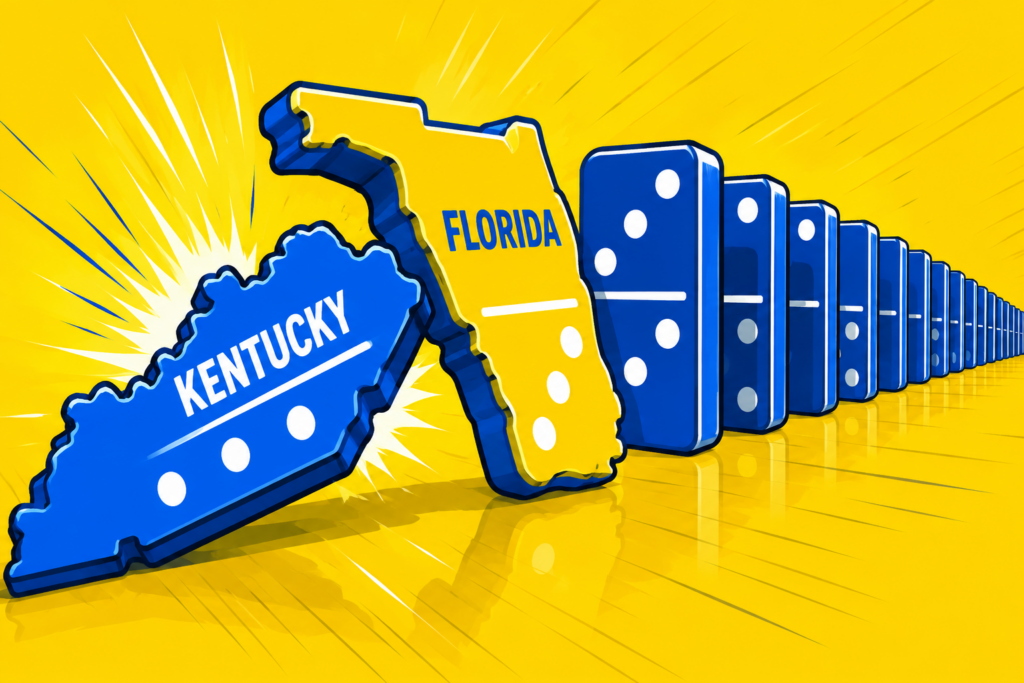
The sweepstakes gaming industry is reacting to Google’s amendment of its Gambling and Games Advertising Policy to directly reference “sweepstake casinos” for the first time. The change appears under the section covering social casino games.
Google’s clarification that “sweepstakes casinos are not social casino games” sent ripples through the online gaming world. Overnight, sweepstakes operators like Pulsz, WOW Vegas, and McLuck found themselves reclassified from “social entertainment” to “gambling.”
Tomer Imber, senior director of sales in United States gaming at Optimove — a customer-relationship management (CRM) platform that runs tailored marketing campaigns across multiple channels for companies — spoke with Sweepsy about the significant implications of this new Google ad policy for sweepstakes casinos and suggested ways they can adapt to achieve success.
“At a very high level, the sweeps industry as a whole is under a lot of scrutiny,” Imber said. “We see it almost on a weekly basis now with regulation changes and how companies like Google change their terms and conditions that are not in the favor of those operators.
“I think it forces the operators to be more sophisticated and better equipped with tools that they have. The barrier of entry two years ago was almost nothing — just get a legal opinion and you are up and running. Now it’s becoming harder and harder.”
The issue of acquisition
Acquisition will become harder and more expensive for sweepstakes operators who relied on Google Ads as a primary funnel, but Imber said it’s not the end of the world.
“It’s an inflection point — one that highlights why CRM and retention should have been the foundation all along,” he said. “When the top of the funnel narrows, the middle and bottom of the funnel become your growth engine.”
Imber said the operators who win going forward will be those who can:
- Use behavioral data to understand who these players really are
- Personalize communications in real time
- Turn fleeting participation into lasting engagement
Two years ago, to get up and running, operators had to “put some money into acquisition, get the players in, and from there, I don’t want to say ‘easy money’, but it’s relatively straightforward,” Imber said. “Now you have to be more sophisticated. Now you need to really think about it. You need to be using the right tools in order to be successful.”
And if you’re not, Imber said the industry is going to witness the survival of the fittest and the strongest.
“The practical advice is when one door is being shut, just try to get through the window, right?” he said. “The retention opportunity is even bigger than before. Tap into the install base, tap into the customers that you’re acquiring from other channels or those you’ve acquired in the past, and make sure that you provide the most personalized experience to them so that they remember you and they continue to engage with you.”
How operators can adjust and re-strategize
Imber said operators must understand those customers and be able to talk to them through the right channels, with the right messaging to retain them, which will add to their bottom line as a business.
Imber said here’s how the most advanced operators are doing it:
- Re-segmenting their players based on engagement and spend.
- Automating lifecycle journeys that respond to player behavior in real time.
- Using predictive models to identify who’s likely to churn, and when, so they can act before it happens.
- Many are also enhancing engagement through gamification by adding challenges, rewards, and achievements that keep players motivated beyond the initial deposit.
- Optimizing frequency and timing based on each player’s tolerance for messaging, rather than one-size-fits-all cadences.
Optimove works with many sweeps brands, including Modo.us and MyPrize.us.
“We were meeting (the Modo.us) CMO at G2E in Las Vegas the other day, and he was talking about how different they were with their acquisition strategy from day one,” Imber said. “I don’t want to get too much in details on that, but they were not investing as much as you would expect for a brand of that size, and yet they were very successful.”
Imber thinks that one of the key reasons why they were so successful is how good they were at retaining those customers and those players through very personalized communication.
Gamification is also huge, Imber said.
“The whole idea of gamifying the experience to the customers, not just about the game itself, if you will, or the product itself,” he said. “Beyond that, when you think about retention, about bonus distribution and things like that in a gamified way, in order to make it more appealing for the customers, for the players — to retain those. There’s definitely a lot of success stories there.”
‘Owned data’ could be key
Imber believes the most successful sweeps operators in this new Google Ads ecosystem will be the ones that have ownership over their audience relationships, rather than relying on outside platforms like Google.
“These operators will move faster, adapt smarter, and spend more efficiently because they’re not waiting for a platform to give them permission to reach their players,” Imber said. “In other words, the future isn’t about social sweepstakes. It’s about smart marketing, built on owned data, intelligent orchestration, and seamless execution.”